AI Coin Grading & Valuation: The Complete Guide to Automated Numismatics

Written by
Ben Parfitt
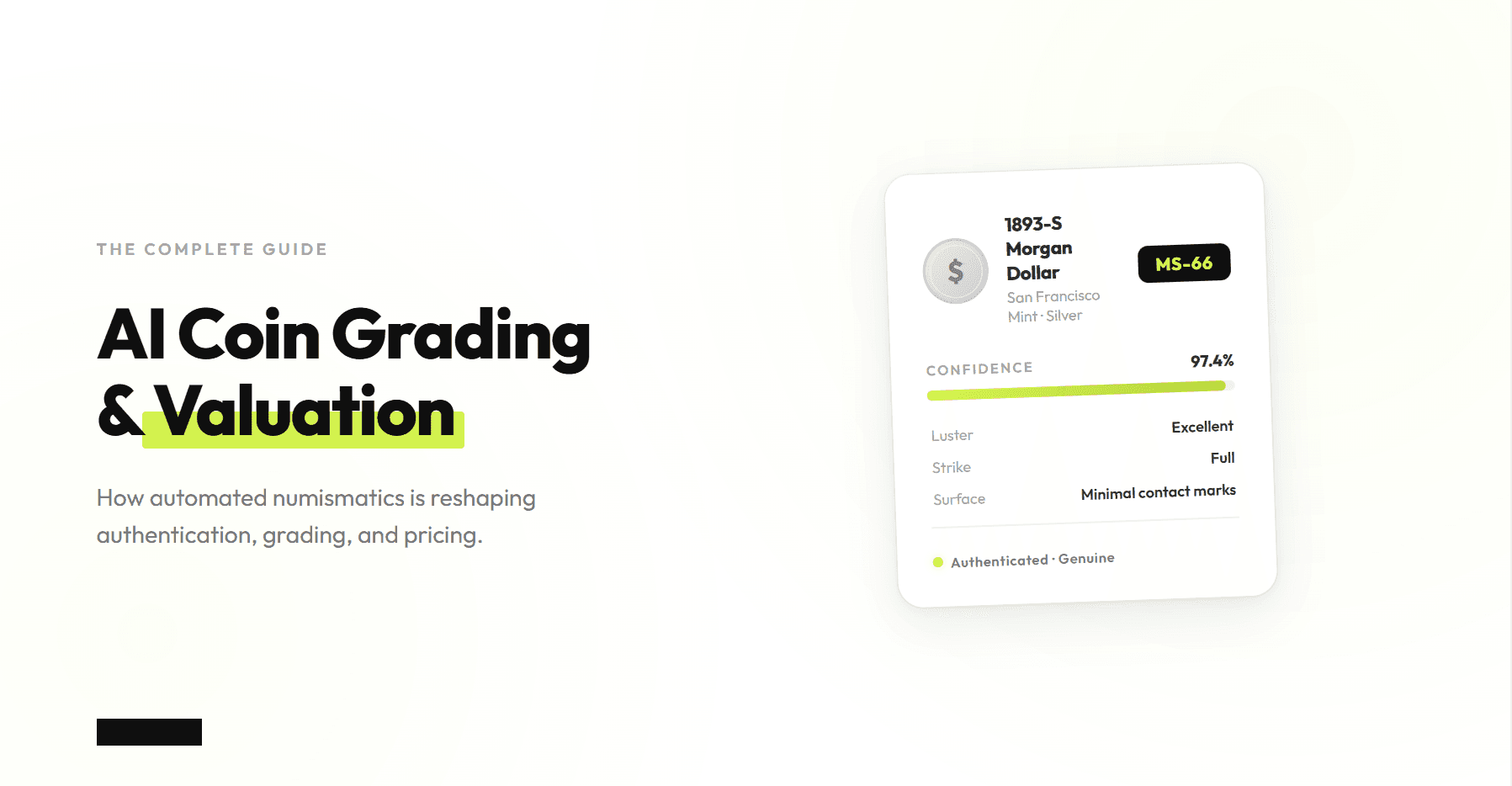
Somewhere right now, a head of appraisals is staring at an inbox full of consignment photos, knowing each one needs expert evaluation, and knowing there aren't enough hours in the week. An estate just came in with 3,000 coins. The backlog already stretches into next quarter. And a dealer down the road is wondering whether the 1909-S VDB in his hand is genuine or one of the increasingly convincing Chinese counterfeits flooding the market.
AI coin grading is changing the equation. Not by replacing the decades of expertise that built numismatics, but by addressing a problem that expertise alone can no longer solve: volume. This guide explains how the technology actually works, where it stands in 2026, where it falls short, and what it means for the collectors, dealers, and platforms that trade in coins every day.
In this guide:
Why Coin Grading Is Ripe for AI
How Does AI Coin Grading Actually Work?
AI Coin Grading vs. Human Expert Grading
The Current State of AI Coin Grading (2026)
What AI Analyzes: Mint Marks, Die Characteristics, and Beyond
Use Cases: From Collector to Enterprise
Limitations and What to Watch For
The Future of AI in Numismatics
FAQ
Why Coin Grading Is Ripe for AI
The numismatics industry has a scale challenge. According to the American Numismatic Association, roughly 140 million Americans have some relationship with coin collecting. PCGS and NGC have graded approximately 97 million coins — an extraordinary achievement across more than three decades. Yet even at that scale, the vast majority of collectible coins in circulation have never been professionally graded, reflecting a market far larger than any traditional service was designed to address.
That gap between supply of expertise and demand for it creates real consequences. Professional grading through PCGS costs $22 for economy submissions to $150 or more for higher-value coins, with turnaround times that reflect the thoroughness of expert evaluation. Those costs are warranted — PCGS certification carries authentication guarantees and market recognition that hold real value. But the sheer volume of ungraded coins means that the vast majority will never be submitted for professional grading at all. For auction houses processing large estate submissions, that volume challenge compounds quickly.
Consider the daily reality of a department head at a mid-size auction house. Their consignment pipeline is backed up with items waiting months for appraisal. Each coin requires identification, authentication, condition grading, and valuation. One specialist, no matter how experienced, can only process so many per day. Meanwhile, large online marketplaces are spending $25 to $30 million per category on manual authentication teams, and still a single person may be responsible for tens of thousands of new listings per month.
The scale of the ungraded market creates a trust gap that affects everyone. Ungraded coins trade at a discount because buyers can't verify what they're getting. Counterfeits slip through in corners of the market where professional grading hasn't reached. Casual collectors stay on the sidelines because they can't justify professional grading for a collection that might (or might not) be worth the investment.
Automated coin grading doesn't eliminate the need for human expertise. But it extends the reach of the industry to serve the millions of collectors, dealers, and platforms that need grading at a pace and scale beyond what expert-driven services were built to handle alone.
How Does AI Coin Grading Actually Work?
Numismatic AI doesn't "look at" a coin the way you do when you tilt a Morgan dollar under a lamp to catch the cartwheel luster. It processes high-resolution images through purpose-built models trained to detect, measure, and classify the same features an expert evaluates, but at a scale of precision and speed that no human can replicate manually.
The difference between coin grading software that actually works and a basic image-matching app comes down to what the model was trained to see. A generic image-recognition system might identify "this is a quarter." A deep category model, built specifically for numismatics, analyzes the same features a veteran grader examines: luster, strike quality, surface preservation, and that holistic quality collectors call "eye appeal."
Here's how each maps to AI analysis:
Luster analysis. AI evaluates light interaction patterns across the coin's surface. The reflectance signatures of original mint luster, cartwheel effect, and the flat, muted appearance of a cleaned coin each produce distinct pixel-level patterns that a well-trained model can differentiate.
Strike quality. The model measures definition and sharpness of design elements, focusing on areas most susceptible to weak strikes. Mint mark depth and clarity, lettering crispness, and the completeness of high-relief features are all quantifiable through image analysis.
Surface preservation. AI detects and classifies contact marks, scratches, hairlines, rim dings, and environmental damage. Each type of surface impairment has a characteristic visual signature, and the model maps their severity and distribution to determine how much they detract from the coin's overall condition.
Eye appeal. This is the holistic assessment. AI integrates weighted scores across all criteria, considering how each factor contributes to the coin's overall visual impression. Where a human grader's "feeling" about eye appeal draws on pattern recognition built over years, the model achieves something similar through trained weighting of quantified attributes.
The critical differentiator in this space is the gap between generic image recognition and purpose-built deep category models. Consumer apps like CoinSnap or Coinoscope match photos against a database of known coin images, which works for basic identification but breaks down for grading and authentication. Production models like Vardera's Deep Category Models are trained on domain-specific features: mint marks, die characteristics, casting variances, and edge lettering. They are built with numismatic expertise embedded in the training data and evaluation criteria.
How that training data is assembled matters enormously. Model quality is a direct function of dataset breadth, the accuracy of expert labeling, and the diversity of conditions, denominations, and years represented. A model trained on a proprietary dataset of 200 million or more unique items, like Vardera's, develops pattern recognition at a fundamentally different level than one trained on a few thousand coin images.
Identification & Authentication
AI coin authentication begins with determining what a coin is: denomination, year, mint, variety. The model matches design elements against known die characteristics for that issue, checking for repunched mint marks (RPMs), doubled dies, and other varieties that affect both identification and value.
For authentication, the model looks for telltale signs of counterfeits. Cast counterfeits, which are poured rather than struck, produce surface textures and edge characteristics that differ from genuine struck coins. The AI flags anomalies in metal flow patterns, surface granularity, and dimensional consistency. PCGS Gold Shield technology, developed in partnership with Positronic, already uses AI-assisted counterfeit detection in production, imaging each coin in high resolution and checking it against PCGS's proprietary database.
Condition Grading on the Sheldon Scale
The Sheldon scale's 1-70 system translates subjective visual assessment into a numerical grade. AI maps its analysis to the same scale, producing a grade estimate based on quantified evaluation of surface preservation, luster, strike, and eye appeal.
Consistency in grading is an inherent challenge with any subjective visual assessment. PCGS addresses this through a rigorous process: three to four independent graders evaluate every coin, none seeing the others' opinions, with additional graders breaking ties. It's an effective system for minimizing subjectivity. AI offers a complementary form of consistency: identical inputs always produce identical outputs. It doesn't have off days, grading drift, or fatigue after hours of evaluation.
Where this gets difficult is at the grade boundaries that matter most. The jump from MS-65 to MS-66 or MS-66 to MS-67 can double or triple a coin's market value. At these boundaries, reasonable experts disagree, and AI models typically express confidence levels rather than absolute certainty.
Valuation & Market Context
Coin valuation software goes beyond grading by incorporating the data an expert would consult after assigning a grade: population counts from PCGS and NGC census data, recent auction realized prices, rarity ratings, demand trends, and condition census information. AI integrates these inputs to produce a market-informed valuation alongside the grade estimate.
This is where AI adds something traditional grading alone doesn't provide. A human grader assigns a grade. But determining what an MS-65 1893-S Morgan dollar should sell for requires cross-referencing auction records, current market demand, and population data. AI can deliver the grade and the market context together, in seconds.
AI Coin Grading vs. Human Expert Grading
If you've spent 30 years building your eye for grade-point distinctions, the question isn't abstract: can AI really do what you do? The honest answer has nuance that most articles on this topic skip.
Where AI excels:
Consistency. No inter-grader variance. No mood, fatigue, or drift. The same coin, photographed the same way, gets the same evaluation every time.
Speed. Seconds per coin versus days or weeks through traditional submission.
Scale. Thousands of coins per hour versus dozens. For operations drowning in volume, this isn't a marginal improvement. It is a category change.
Pixel-level detection. AI catches surface details at magnification levels that are impractical for human review at scale: micro-scratches, subtle die polish lines, hairlines invisible under normal examination.
Where humans still lead:
Edge cases. Unusual toning, artificial versus natural patina, coins with environmental damage that mimics wear. These require contextual judgment that current models handle less reliably.
Historical context. Provenance, pedigree, and the storytelling that turns a rare coin into a storied one. AI doesn't know that this specific Morgan dollar was part of the Eliasberg Collection.
Grade boundary judgment. At the MS-65/66/67 boundaries where a point difference means thousands of dollars, the most experienced graders have an intuitive calibration that current AI approaches but doesn't match.
Coin grading AI accuracy across the market:
Type | Example | Accuracy Metric |
|---|---|---|
Consumer identification apps | CoinSnap | 99% identification accuracy across 300K+ types, but grading is unreliable per user reviews |
Specialized US grading apps | CoinKnow | Within 2 grade points on the Sheldon scale for US coins |
Production deep category models | 97-99% authentication accuracy analyzing domain-specific features |
The right framing isn't "AI versus humans." It is AI plus humans. AI handles the 80% of routine identification, authentication, and grading that consumes expert time, freeing specialists to focus on the 20% that genuinely demands their experience: high-value edge cases, provenance research, and the client relationships that drive an auction house's reputation.
Your expertise isn't threatened. It's amplified.
The Current State of AI Coin Grading (2026)
The AI coin grading landscape in 2026 spans a wide maturity spectrum, from consumer apps that run on a smartphone camera to production infrastructure processing thousands of coins per hour for enterprise clients.
Consumer apps target individual collectors:
CoinSnap leads in downloads (over 1 million) with identification across 300,000+ coin types. Grading and valuation features exist but are widely considered unreliable, and the app cannot detect error coins or counterfeits.
CoinKnow focuses on US coins with more accurate grading (within a 2-point Sheldon range) and automatic error coin detection, a significant improvement for serious collectors.
Numi applies large language model analysis to coin images, representing a newer approach to AI-powered coin identification.
Pre-grading tools serve collectors evaluating whether professional submission is worth the cost:
CoinGrader AI provides free instant grade estimates before PCGS or NGC submission, delivering results in under 10 seconds. Helps collectors make informed submission decisions by identifying which coins are most likely to benefit from professional certification.
Industry adoption by traditional grading services:
PCGS AI grading integration through Gold Shield, developed with Positronic, uses AI to assist human graders with counterfeit detection. Each coin is imaged in high resolution and checked against PCGS's proprietary imaging database. This is a strong signal of AI's role in the future of numismatics — the industry's most respected grading service integrating AI into its own workflow.
Production infrastructure for enterprise operations:
Purpose-built deep category models designed for B2B integration represent the highest tier of the technology. These are not consumer apps. They are coin grading software built for auction houses clearing consignment backlogs and marketplaces authenticating listings at scale via API. Vardera's coin category model is the world's first production AI coin model, live and in customers' hands, achieving 97-99% authentication accuracy by analyzing mint marks, casting variances, and domain-specific features. Trained on a proprietary dataset of 200 million or more unique items, it delivers results in seconds versus the weeks or months traditional appraisal requires.
Consumer App | Pre-Grading Tool | Production Category Model | |
|---|---|---|---|
Example | CoinSnap, CoinKnow | CoinGrader AI | |
Primary user | Individual collectors | Collectors evaluating submission | Auction houses, marketplaces |
Scope | Identification, basic value | Grade estimation | Authentication, grading, valuation, cataloging |
Integration | Standalone mobile app | Web-based | API infrastructure |
Accuracy | High for ID, low for grading | Within 2 points for some | 97-99% authentication |
Counterfeit detection | No | Limited | Yes, analyzing casting and die characteristics |
Use case | "What is this coin worth?" | "Which coins deserve PCGS certification?" | "Process 10,000 estate coins by Thursday" |
Explore how production AI coin grading works
What AI Analyzes: Mint Marks, Die Characteristics, and Beyond
This is the section no other guide on this topic has written, because most content about AI coin grading is produced by people who understand AI but not numismatics. Here's what a serious model actually examines.
Mint mark analysis: AI identifies and assesses mint mark position, depth, clarity, and consistency. For collectors and dealers, this is where varieties hide. Repunched mint marks (RPMs), tilted mint marks, and over-mint marks are features that can transform an ordinary coin into a valuable variety. Production models like Vardera's Deep Category Models, trained specifically on numismatic data, detect these features at a level of consistency that matters when processing hundreds or thousands of coins.
Die characteristics: Every coin carries the fingerprint of the die that struck it. AI reads die polish lines, die cracks, die clash marks, and doubled dies. These features create the varieties that drive collector interest and premium pricing. A 1955 doubled die Lincoln cent looks like any other penny to a generic image classifier. A purpose-built numismatic model recognizes the doubling pattern as a diagnostic feature worth thousands.
Casting variance detection: This is the front line of AI coin authentication. Cast counterfeits, produced by pouring metal into a mold rather than striking with a die, leave characteristic evidence: surface texture that lacks the flow lines of a struck coin, edge characteristics that differ from genuine reeded or lettered edges, and metal density anomalies visible in surface granularity. AI maps these signatures against known genuine examples to flag probable fakes.
Surface topology mapping: The model builds a detailed surface map to detect cleaning, whizzing (mechanical surface alteration), artificial toning, and environmental damage. Each type of alteration leaves a distinct visual pattern. Cleaning creates unnatural reflectance. Whizzing leaves directional striations. Artificial toning produces color distributions that differ from the gradual oxide patterns of natural toning. Academic research on image analysis for numismatics has demonstrated that deep learning can detect these "unexpected elements" with increasing reliability.
Edge and rim analysis: Edge lettering, reeding count, and rim condition are often overlooked by basic identification apps but are critical for authentication of many coin types. AI evaluates these features when image quality permits, adding another layer to the authentication profile.
Use Cases: From Collector to Enterprise
Individual collectors use AI coin grading as a pre-screening tool to make smarter submission decisions. Instead of guessing which coins merit PCGS or NGC certification, you get an instant estimate of likely grade and value — helping you identify the coins most worth submitting and avoid spending $22 or more on pieces that don't justify it. AI-powered tools also help identify error coins and varieties that might otherwise sit unrecognized in a collection, and assist with cataloging and organizing large inherited collections.
Dealers and auction houses face the volume challenge most directly. An estate comes in with thousands of coins. Processing that through expert evaluation alone means months of specialist time to identify, authenticate, grade, and value each one. Automated coin grading compresses that timeline from months to days. The AI handles the initial triage: what is it, is it genuine, what's the approximate grade and value. Specialists then focus their time on the items that need expert judgment (the high-value coins at grade boundaries, the unusual pieces, the coins with provenance stories). This also opens the door to new categories. An auction house with deep expertise in American silver coins can take on a consignment of ancient Roman coins without hiring a new specialist for the category.
Marketplaces and e-commerce platforms operate at an entirely different scale. When you're responsible for tens of thousands of new coin listings per month, manual authentication is economically unsustainable. Platforms spend $25 to $30 million per category on authentication teams and still can't catch everything. Building an in-house AI solution costs $1 to $3 million and one to two years per category. Production category models like Vardera's coin model, already live and in customers' hands, offer plug-and-play authentication infrastructure via API that lets a marketplace launch or scale a coin category without that investment. Listings get automatically authenticated, descriptions enriched, and condition assessed, improving buyer trust and reducing chargebacks.
Limitations and What to Watch For
Honest limitations make the strengths more credible. Here's where AI coin grading hits its current boundaries.
Photo quality dependency: AI is only as good as the images it receives. Poor lighting, low resolution, obstructed views, or inconsistent angles degrade accuracy significantly. Professional-quality imaging produces the best results, which is one reason enterprise deployments with controlled imaging environments outperform consumer apps relying on smartphone cameras.
Grade boundary uncertainty: The MS-65/66/67 boundaries that drive the biggest price jumps are difficult for AI, just as they are for human graders. Current models handle this by expressing confidence levels rather than definitive grades when the analysis falls near a boundary. This is a feature, not a bug. It signals "get an expert opinion" precisely when an expert opinion matters most.
Toning and artificial enhancement: Natural versus artificial toning remains a challenge. The visual signatures overlap enough that even experienced graders disagree on some pieces. AI models are improving in this area but are not yet definitive.
Data privacy: When you upload coin images to an app or service, your data goes somewhere. CoinWeek's analysis of CoinSnap revealed privacy practices worth scrutinizing. Enterprise-grade solutions should offer clear data ownership guarantees and transparent policies about how images are stored and used.
AI is not certification: An AI grade estimate does not replace PCGS or NGC certification for market transactions. It is a complementary tool. Serious transactions still benefit from the guarantee, warranty, and market recognition that comes with professional slabbing. Think of AI grading as the triage layer that makes professional grading more efficient, not the replacement for it.
The Future of AI in Numismatics
The trajectory of numismatic AI points toward a fundamental shift in how physical assets are valued, authenticated, and traded. Not a shift away from expertise, but a shift in what expertise is applied to.
Category expansion is already underway: The same deep learning infrastructure that powers coin grading applies to comics, trading cards, luxury goods, and wine. Vardera has six or more category models in various stages of development, with coins live, comics nearing completion, and trading cards in active development. Each new category builds on shared infrastructure, making subsequent launches faster than the first.
The data flywheel compounds: More coins processed means more data. More data means smarter models. Smarter models attract more users, generating more data. This compounding dynamic, built on a foundation of 200 million or more unique items, creates a defensible advantage that widens over time. The first production-grade model to achieve critical mass in a category becomes increasingly difficult to catch.
Hybrid workflows are the near-term standard: AI handles the initial triage, identification, and grading. Human experts verify edge cases and add the contextual judgment (provenance, historical significance, market nuance) that no model captures yet. This isn't a transition period before AI takes over. It is the architecture that makes the most sense for a market where accuracy at the margins has enormous financial consequences.
Real-time market intelligence is the next frontier: AI that doesn't just grade a coin but provides live valuation tied to current auction data, population counts, and demand trends. The grade and the market context delivered together, updated continuously as conditions change. The concept of a "valuation layer," foundational infrastructure for any platform trading physical assets, is the logical endpoint.
Within the next few years, the most consequential change in numismatics won't be a new coin discovery or a record auction price. It will be the moment when AI-powered authentication becomes the default first step in every coin transaction, from a $20 estate sale find to a $2 million auction lot. The expertise of human graders will matter more than ever. They'll just spend their time on work that actually deserves it.
FAQ: AI Coin Grading
How accurate is AI coin grading?
Accuracy varies significantly by platform and purpose. Consumer identification apps like CoinSnap achieve approximately 99% identification accuracy for coin type, but their grading estimates are less reliable. Specialized tools like CoinKnow achieve grading accuracy within a 2-point range on the Sheldon scale for US coins. Production-grade deep category models achieve 97-99% authentication accuracy by analyzing domain-specific features like mint marks and casting variances.
Can AI detect counterfeit coins?
Yes, at the production level. Deep category models trained on the visual signatures of cast versus struck coins can identify counterfeits by detecting anomalies in surface texture, edge characteristics, and metal flow patterns. Consumer apps generally cannot detect counterfeits. PCGS has integrated AI-powered counterfeit detection through its Gold Shield technology.
Will AI replace PCGS and NGC?
No. AI coin grading complements professional certification rather than replacing it. An AI grade estimate does not carry the market recognition, guarantee, or warranty of a PCGS or NGC slab. However, AI is increasingly used to pre-screen coins before professional submission and to assist within the grading process itself, as PCGS demonstrated with Gold Shield.
What is the best AI coin grading app?
It depends on your use case. For casual identification, CoinSnap has the broadest database. For US coin grading specifically, CoinKnow offers better accuracy with error coin detection. For pre-grading before PCGS/NGC submission, CoinGrader AI provides free instant estimates. For enterprise-scale authentication and grading, production category models like Vardera's offer API-based infrastructure.
How much does AI coin grading cost?
Consumer apps range from free to subscription-based (typically $5 to $15 per month). CoinGrader AI offers free basic estimates. Enterprise production models are typically priced per API call or through volume-based agreements, with economics designed to be significantly below the cost of manual expert authentication per item.
Is AI coin grading reliable enough for valuable coins?
For high-value coins at contested grade boundaries (the difference between an MS-66 and MS-67 that might mean thousands of dollars), professional human grading remains advisable. AI is most reliably used as a triage and pre-screening tool: identifying what a coin is, flagging counterfeits, providing a grade estimate, and determining whether professional certification is worth pursuing. For bulk authentication and processing, production AI delivers reliability at a scale that manual processes cannot match.
Written by
Ben Parfitt
Want to see Vardera in action?