Why Generic Image Recognition Fails for Numismatic Authentication

Written by
Derek Bugley
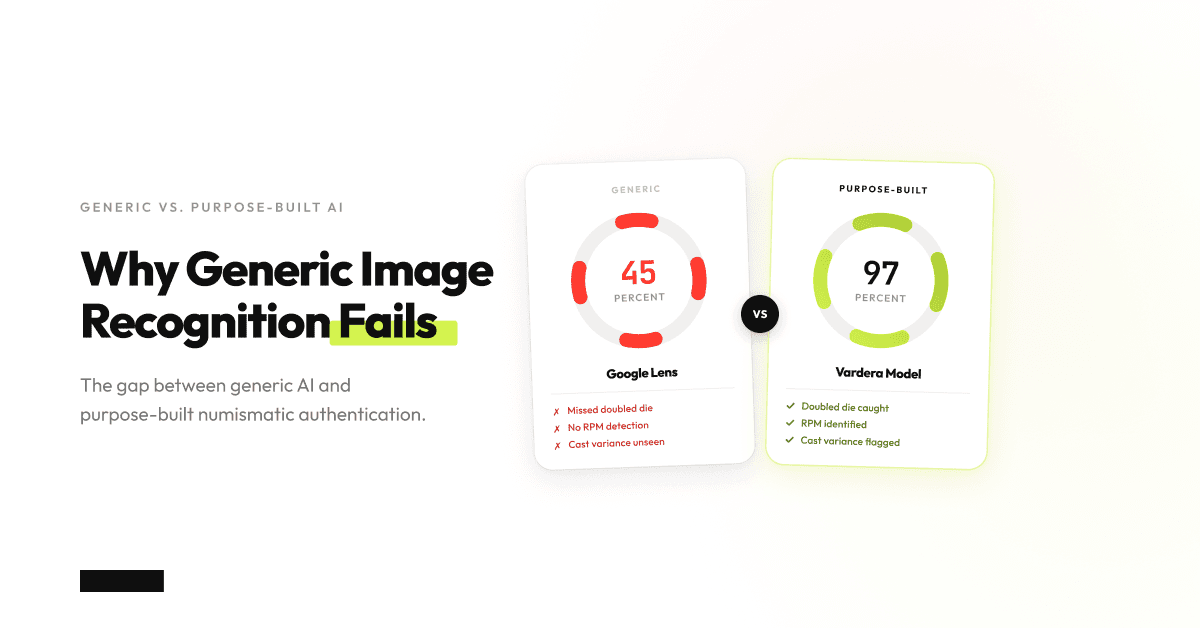
Point Google Lens at a 1916-D Mercury Dime and it will tell you that you are looking at a Mercury Dime. What it will not tell you is whether that coin is genuine, whether the mint mark has been added or altered, or whether the strike quality warrants a VF-30 or an AU-55 grade. That gap between identification and authentication is where organizations spending $25-30M per category on manual authentication need to pay attention.
With Google Lens processing over 20 billion visual searches per month as of early 2026, it is no surprise that marketplaces, grading services, and auction houses are exploring whether free, general-purpose image recognition could solve their authentication bottleneck. Google Lens coins queries keep climbing. The short answer: generic tools cannot fill this gap. Here is exactly why, what they get right, and what purpose-built numismatic AI infrastructure actually delivers.
Capability | Google Lens | Consumer Coin Apps | Purpose-Built Numismatic AI |
|---|---|---|---|
Basic coin identification | ~85% similar match | 90-99% claimed | 97-99% verified |
Mint mark analysis | No | Limited | Yes, sub-millimeter |
Die variety detection | No | No | Yes |
Condition/grade assessment | No | Basic estimate | Production-grade |
Counterfeit detection | No | No | Yes, 97-99% accuracy |
Market valuation context | No | Basic pricing | Population data + price trends |
API/enterprise integration | No | No | Yes, built for scale |
Processing volume | One at a time | One at a time | Thousands per hour |
Google Lens Coin Identification: What Generic Image Recognition Actually Does
Google Lens uses a general-purpose neural network trained on billions of web images to match visual patterns against indexed content. When you point it at a coin, it performs a visual similarity search, comparing the image against everything Google has indexed, from product listings to Wikipedia pages to collector forum posts.
For common, modern coins in good condition, this works reasonably well. Testing data shows Google Lens achieves roughly 85% accuracy in finding visually similar items and approximately 45% accuracy in identifying the exact same object. Users on numismatic forums report that it handles Roman-era coins better than Greek coins, and struggles with worn, damaged, or regionally uncommon specimens.
That performance profile reveals the core issue. Google Lens was built to answer "what is this thing?" across every possible category, from plants to furniture to landmarks. It was never designed to answer the questions that matter in numismatics: Is this coin genuine? What is its precise grade? What die variety is it? What should it sell for?
AI Coin Authentication vs. Identification: The Gap Generic Tools Cannot Close
The distinction between identification and authentication is not a technicality. It is the difference between a tool that costs nothing and provides hobby-level utility, and infrastructure that protects millions in transaction value.
Identification: "This is a 1921 Morgan Silver Dollar."
Authentication: "This is a genuine 1921 Morgan Silver Dollar, struck at the Philadelphia Mint, graded MS-64 based on strike quality, luster analysis, and surface condition, with a current market value range of $110-$150 based on population data and recent auction results."
The second answer requires analyzing features that generic coin image recognition cannot see. Consider what a human expert examines during AI coin authentication:
Mint marks: Sub-millimeter stamps that vary by year, location, and die state
Die varieties: Doubled dies, repunched mint marks, and overdate errors that differentiate a $50 coin from a $50,000 coin
Strike quality: The sharpness of design elements, which varies by die wear and striking pressure
Surface analysis: Luster patterns, contact marks, hairlines, and signs of cleaning or alteration
Edge characteristics: Reeding count, edge lettering consistency, and seam indicators
Organizations spending $25-30M annually per category on manual authentication are not paying for coin identification. They are paying for the precision analysis that separates genuine coins from counterfeits, and that assigns the accurate grade determining market value. When one person is responsible for 25,000+ monthly coin listings, the gap between identification and authentication becomes a trust and safety liability.
Where Google Lens Falls Short: Five Technical Limitations for Coin Image Recognition
1. No Mint Mark Analysis
Mint marks are tiny letters stamped onto coins indicating the manufacturing facility. The difference between a 1916 Mercury Dime with a "D" mint mark (worth $1,000+) and one without (worth $5-10) comes down to a detail smaller than a pinhead. Google Lens treats the entire coin as one visual pattern. It has no training data teaching it to isolate, magnify, and classify mint marks across thousands of die variations.
2. No Die Variety Detection
Die varieties, including doubled die obverses (DDO), repunched mint marks (RPM), and overdate errors, are among the most valuable features in numismatics. A 1955 Doubled Die Lincoln Cent is worth $1,000-$2,000 or more. The standard 1955 Lincoln Cent is worth under a dollar. Google Lens cannot distinguish between them because it lacks the specialized training data and micro-feature detection algorithms required.
3. No Surface Condition Grading
Coin grading AI requires assessing strike quality, luster patterns, and surface conditions at a level of detail that general image recognition ignores. The difference between an MS-63 and an MS-65 grade can mean a 2-5x price difference, yet the visual distinction involves analyzing light reflection patterns, microscopic contact marks, and the depth of design element impression. A general coin identification app, let alone Google Lens, does not evaluate these features.
4. No Counterfeit Detection
The global counterfeit coin detection market reached an estimated $500 million in 2025, growing at 7% CAGR. The scale of the problem is staggering: Chinese counterfeiting operations alone can produce hundreds of thousands of counterfeit U.S. coins per month, with quality that has fooled experienced dealers and seasoned collectors. Modern counterfeits use advanced casting and striking techniques that produce coins visually identical to genuine specimens in standard photographs. Detecting them requires analyzing casting flow patterns, die polish characteristics, metal composition indicators visible in surface texture, and weight/dimension variances. Research from Concordia University demonstrates that AI systems using fuzzy association rules and image-mining techniques can identify subtle flaws invisible to the naked eye, but only when trained specifically on counterfeit detection data.
5. No Market Intelligence Integration
Google Lens has no concept of population data, price trends, or auction history. It cannot tell you that only 400 examples of a particular coin exist in a given grade, that prices for that variety have increased 30% in the past year, or that similar specimens at recent auction averaged a specific hammer price. PCGS and NGC have graded nearly 70 million coins over three decades, generating population reports that directly influence market pricing. For organizations managing trust and safety on marketplace listings or running grading operations, this context is not optional.
What Purpose-Built Numismatic AI Does Differently
The limitations above are not fixable with better prompts or higher-resolution photos. They stem from a fundamental architectural difference: general-purpose image recognition was designed to classify billions of object categories at surface level. Numismatic AI infrastructure is designed to analyze one category with extreme depth.
Purpose-built coin authentication models, like Vardera Labs' deep category models, differ from generic tools in several critical ways:
Domain-specific training data: Rather than training on general web images, these models learn from 200M+ items of proprietary numismatic data, including high-resolution coin images, grading records, population reports, auction results, and known counterfeit specimens. This creates a data moat that generic tools cannot replicate.
Micro-feature detection: Purpose-built models analyze mint marks, die varieties, strike characteristics, and surface conditions at sub-millimeter precision. They are trained to see the exact features that determine authenticity and grade, not just visual similarity to web-indexed images.
Authentication accuracy: Where Google Lens achieves ~45% exact identification accuracy, production-grade numismatic AI delivers 97-99% authentication accuracy. This is the difference between a curiosity tool and infrastructure you can build a business on.
Market intelligence layer: Deep category models integrate population data, historical pricing, and auction trends to provide valuation context alongside authentication. The model does not just confirm a coin is genuine; it tells you what that coin is worth and why.
API infrastructure for scale: Consumer tools process one coin at a time through a phone camera. Purpose-built numismatic AI operates as API infrastructure, processing thousands of coins per hour with consistent accuracy. Vardera Labs' coin model is live and in production, delivering this capability today. For marketplace teams managing listing hygiene across tens of thousands of submissions, or grading operations looking to reduce turnaround time without sacrificing accuracy, API integration is the differentiator.
Compounding accuracy: Every coin processed through the system feeds back into the training data, creating a compounding data flywheel. The more volume the system handles, the smarter it becomes, particularly for edge cases like cleaned coins, environmental damage, and altered surfaces.
Choosing the Right Coin Identification App: A Decision Framework
Not every use case demands the same tool. The right choice depends on your volume, accuracy requirements, and whether you need identification or authentication.
Choose Google Lens if:
You need a quick, free identification of a common modern coin
Accuracy below 50% for exact identification is acceptable
You have no authentication, grading, or valuation requirements
You are processing coins one at a time, casually
Choose a consumer coin identification app (Coinoscope, CoinSnap, Maktun) if:
You are a collector managing a personal collection
You need identification across a broad database (300,000+ coin types)
Approximate valuations are sufficient
You process a small volume and do not need API integration
Choose purpose-built numismatic AI infrastructure if:
You manage 1,000+ coin listings or submissions monthly
Authentication accuracy above 97% is a business requirement
You need counterfeit detection, not just identification
Grading consistency and defensible condition reports matter
You need API integration into existing workflows
Processing time measured in seconds rather than the weeks or months that thorough manual grading services typically require for economy-tier submissions
The cost equation reinforces the distinction. Manual authentication at scale costs $25-30M per category annually. Building an in-house solution takes $1-3M and 1-2 years per category. Purpose-built API infrastructure lets you deploy production-grade authentication without either investment.
Frequently Asked Questions
Can Google Lens identify rare coins?
Google Lens can match a rare coin to visually similar images on the web, but it cannot determine rarity, authenticate the coin, or assess its condition. For rare coins, specialized numismatic AI or professional human graders are required because the features that make a coin rare (die varieties, mint mark anomalies, survival rates) are invisible to general-purpose image recognition.
What accuracy does AI coin authentication achieve?
Consumer coin identification apps claim 90-99% accuracy for basic identification (matching a coin to its type and denomination). Purpose-built numismatic AI, such as deep category models trained on proprietary datasets, achieves 97-99% accuracy for full authentication, including counterfeit detection, grade assessment, and die variety identification. The accuracy gap comes from training data depth: 200M+ items of domain-specific data versus general web images.
How does AI detect counterfeit coins?
AI counterfeit coin detection works by analyzing micro-features invisible to the naked eye. Research published in Expert Systems with Applications describes systems using image-mining and machine learning to segment coin images into regions and analyze color, texture, shape, and size patterns. Purpose-built models compare these patterns against known genuine specimens and documented counterfeit characteristics, flagging casting anomalies, incorrect die polish patterns, and surface texture inconsistencies.
What is the difference between coin identification and coin authentication?
Coin identification determines what a coin is: its denomination, year, country, and type. Coin authentication confirms whether a specific coin is genuine, assigns a condition grade, detects counterfeits, and provides market valuation. Identification requires matching a photo to a database. Authentication requires analyzing mint marks, die characteristics, surface conditions, and comparing against known authentic and counterfeit specimens. For professional operations, this distinction determines whether a tool provides hobby-level convenience or production-grade infrastructure.
Making the Right Infrastructure Decision: Beyond Google Lens Coins
The question is not whether Google Lens works for coins. It does, for casual identification of common specimens. But the Google Lens coins experience stops at identification. The question is whether your operation can afford to build on a tool that answers only the easiest question in numismatics.
Consider your decision in three tiers:
If you process fewer than 100 coins per month and need basic identification only, free tools like Google Lens coin identification serve the purpose.
If you process 100-1,000 coins per month and need reliable identification plus approximate values, consumer apps provide adequate utility with the caveat that authentication and counterfeit detection are not included.
If you process 1,000+ coins per month, require defensible authentication, or carry financial liability for listing accuracy, purpose-built AI infrastructure is not a luxury; it is a cost-of-doing-business decision that pays for itself against $25-30M annual manual authentication budgets.
The numismatic AI category is young. Vardera Labs shipped the world's first production coin category model, and the technology's accuracy compounds with every coin processed. The organizations that integrate this infrastructure now will build a compounding advantage in listing hygiene, trust and safety, and operational efficiency.
Written by
Derek Bugley
Want to see Vardera in action?