How Grading Bodies Can Scale Without Cutting Corners

Written by
Ben Parfitt
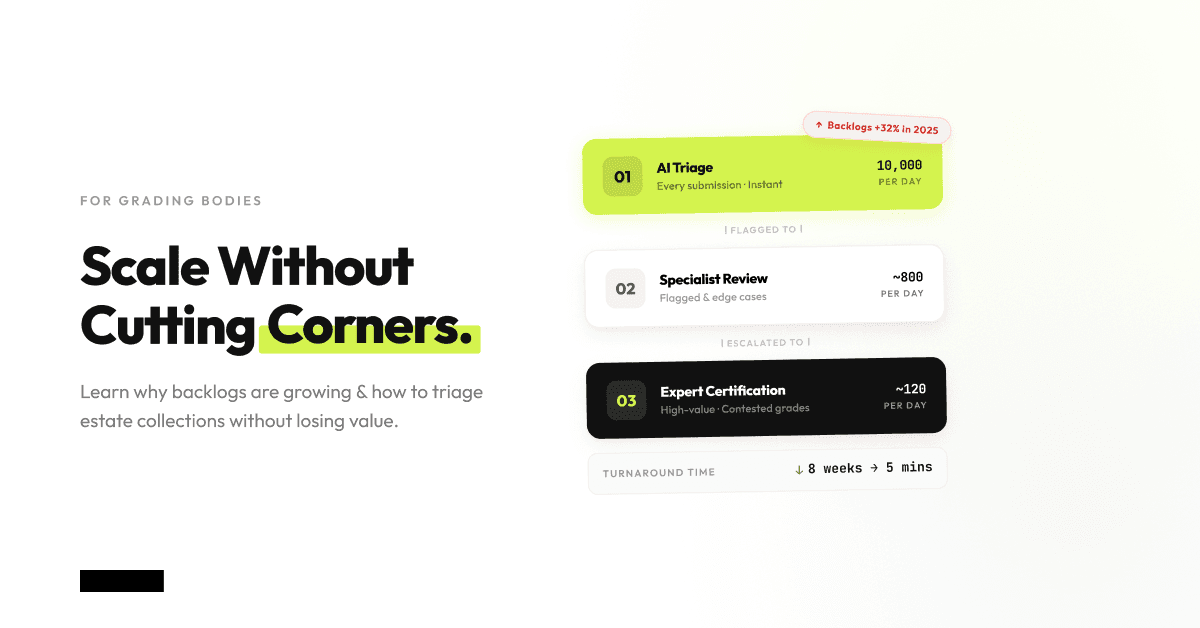
In 2025, major grading services processed a record 26.8 million cards alone, a 32% jump from the prior year. Coin grading demand is surging in parallel, with the global coin grading services market projected to grow from $1.2 billion to $2.8 billion by 2033. Yet the grading submission backlog at every major service keeps growing faster than capacity can follow.
If you run grading operations, you already feel this. Turnaround times are stretching. Pricing adjustments buy breathing room but not throughput. And the one thing you cannot compromise, accuracy, is exactly what makes scaling so difficult. This guide breaks down why traditional approaches stall and lays out a three-layer framework for increasing capacity without weakening certification standards.
The Grading Submission Backlog Has Become an Industry-Wide Crisis
The numbers tell a clear story of collectible grading volume outpacing capacity across every major category.
Recent data paints a clear picture:
PSA reports submission volumes at "unprecedented levels" in 2026, with bulk orders taking roughly four months from arrival to completion
PCGS coin submissions have seen economy-tier turnaround times extend beyond 200 days as demand continues to outpace available capacity, with additional time needed for variety attribution
Card grading volume jumped 32% year-over-year in 2025, per GemRate data reported by Sports Illustrated
This is not a temporary spike. The coin collecting market alone is expanding at a 9.7% compound annual growth rate, and new collectible categories (trading cards, comics, memorabilia) are adding submission volume from entirely new collector demographics. PCGS has graded over 42.5 million coins, medals, and tokens to date, and the pace is accelerating.
Every major grading body is facing the same question: how do you handle volumes that one expert cannot possibly review alone without diluting the certification your customers trust?
Why Traditional Grading Capacity Scaling Hits a Ceiling
The instinctive response to a grading submission backlog is to hire more graders, expand facilities, and extend operating hours. Every major service has tried this. The results are real but limited.
Hiring and training take years, not months: PSA requires new graders to complete a training program that includes more than 13,000 test card trials before they grade customer submissions. Coin grading demands even deeper specialization: knowledge of die varieties, mint mark authentication, surface diagnostics, and historical context that takes a decade of numismatic experience to internalize. Even aggressive hiring sprees add only a handful of qualified graders at a time.
Facility expansion is significant but demand keeps pace: PSA grew daily throughput from 15,000 cards per day in 2021 to 90,000 cards per day in 2025, a remarkable 6x increase that required new grading centers in Boca Raton, Plano, and planned facilities in Frankfurt and Toronto. Even with this investment, submission growth has continued to push turnaround times and pricing upward. PSA adjusted prices twice in six months (September 2025 and February 2026) while extending turnaround estimates to manage the influx.
Pricing adjustments help manage submission flow: When PSA raised Value Plus pricing from $39.99 to $49.99 and extended turnaround from 40 to 45 business days, per DraftKings Network reporting, the adjustment helped moderate submission volume at lower tiers. This is a practical approach to managing demand, though it also means some collectors defer submissions or explore alternative services.
As one industry observer noted, grading remains a "tedious manual process where you can't just tell somebody to work more and work harder". The fundamental constraint is not space or willingness. It is the number of human experts qualified to render a grade your market trusts. And that constraint is compounded by the retirement cliff hitting senior specialists across the industry.
The Real Cost of Certification Turnaround Delays
Slow turnaround does not just frustrate submitters. It erodes the entire ecosystem a grading body depends on.
Item values decline in limbo: Analysis of PCGS-graded medals shows that each week beyond 60 days in grading costs 1-2% of item value. For modern commemorative coins, the price erosion is steeper: one study tracked a 5% monthly decline in PCGS MS70 prices during extended grading delays. When items lose value while waiting for certification, submitters start questioning whether grading is worth the cost.
Submitters are diversifying across services: In 2025, CGC grew card grading volume by 121% and TAG by 83%, while PSA's sports card volume grew 2% as the overall market expanded. As turnaround times lengthen across the industry, submitters increasingly spread their volume across multiple services. The cost of manual authentication already runs into the tens of millions per category, and serving this growing demand remains a challenge for every grading body.
Population report timeliness is affected: Every coin grading backlog delays the population data that collectors, dealers, and auction houses rely on for pricing decisions. If it takes six months for a submission run to clear, the population report lags behind reality. Keeping this data current is essential to maintaining the market infrastructure that gives certified grades their value.
How to Reduce Your Grading Turnaround Time Without Compromising Accuracy
The path forward is not choosing between speed and accuracy. It is restructuring grading workflows so human expertise is concentrated where it matters most, while technology handles the high-volume, pattern-recognition-heavy work that currently consumes most of a grader's day.
Here is a three-layer framework that grading bodies can adopt incrementally.
Layer 1: Intelligent Submission Triage
Before a single item reaches a grader's bench, automated triage can classify incoming submissions by category, estimated complexity, and required expertise level. Straightforward modern issues (common dates, standard varieties, clean surfaces) follow an accelerated pipeline. Items with potential die varieties, questionable surfaces, or high declared values route to senior graders.
This is the same principle behind emergency room triage: not every patient needs a surgeon. The goal is to match expertise to complexity, so your most experienced numismatists spend their time on the submissions that genuinely require their judgment.
Layer 2: AI-Augmented Pre-Screening
This is the layer where processing time drops from weeks to seconds.
Purpose-built AI models can pre-screen submissions for condition assessment (strike quality, luster, surface analysis), authentication (counterfeit detection through pattern recognition), and classification (die variety identification, mint mark analysis). These models work from high-resolution imagery and compare against databases of millions of known items.
The output is not a final grade. It is a pre-populated grading worksheet: here is what the model detected, here is the recommended grade range, here are any flags for potential counterfeits or altered surfaces. The human expert reviews and confirms rather than starting from zero. That review takes a fraction of the time a full manual assessment requires.
Computer vision technology is already being deployed in this way. It evaluates corner sharpness, detects microscopic surface imperfections, computes centering, and identifies printing defects with consistency that does not degrade after eight hours on the bench.
Layer 3: Expert-Led Final Certification
The final grade still comes from a human expert. This is non-negotiable for maintaining the trust that underpins your certification.
But with Layers 1 and 2 in place, that expert is reviewing a pre-screened, pre-classified submission with a suggested grade range and flagged areas of concern. Their focus shifts from "What am I looking at?" to "Do I agree with this assessment?" Edge cases, high-value items, and anything flagged as potentially altered or counterfeit get full manual review. Straightforward items get efficient expert confirmation.
The result: your graders' expertise is amplified rather than diluted. Each grader can certify more items per day while spending more time on the complex submissions that actually require deep numismatic knowledge.
What AI-Assisted Grading Looks Like in Production
This is not theoretical. Multiple organizations are already investing in AI-augmented grading infrastructure.
CSG announced that alongside hiring and expanded workspace, it has been "developing and acquiring advanced authentication and grading technology, such as proprietary AI software." TAG Grading uses patented computer vision and photometric stereoscopic imaging for grading accuracy. AGS claims to grade cards 10x faster than traditional methods using AI.
For coin grading specifically, the technology has matured to the point where purpose-built deep category models achieve 97-99% authentication accuracy by analyzing mint marks, casting variances, and edge cases across training datasets of 200M+ unique items. These are not generic image recognition tools (which fail for numismatic applications). They are production-grade models trained on the specific visual characteristics that define a grade: strike sharpness, luster depth, surface preservation, and die variety signatures.
The processing speed difference is stark. What takes a human grader minutes of careful examination under magnification, the model completes in seconds. Multiply that across thousands of daily submissions, and the throughput impact becomes clear.
Want to understand the technical details behind AI-powered coin analysis? Read our guide to how AI reads mint marks and detects die varieties.
Protecting Your Standards While Increasing Throughput
If you have spent decades building a reputation for grading accuracy, the idea of introducing AI into your workflow raises an understandable concern: will this weaken our standards?
The short answer is no, if the architecture is right.
The AI does not replace the grade. It prepares for the grade: Think of it as the difference between a radiologist reading a scan cold versus reviewing a scan where the imaging software has already highlighted areas of concern. The radiologist makes the diagnosis. The software ensures nothing gets missed and reduces the time to reach a conclusion.
Consistency actually improves: Grading inherently involves subjective judgment, and even highly skilled experts can show natural variability across sessions. Industry observers note that resubmissions can sometimes yield different results, reflecting the genuine difficulty of borderline calls rather than any shortcoming of a particular service. AI pre-screening provides an objective baseline that does not vary with fatigue or time of day. When paired with human judgment on final certification, the combined output is more consistent than either alone.
The authentication backlog clears because routine items move faster, not because standards drop: In most submission populations, roughly 80% of items are straightforward: common dates, standard varieties, no authentication concerns. AI handles the preliminary assessment on these, and your graders confirm. That frees expert bandwidth for the 20% that genuinely needs deep analysis: rare varieties, potential counterfeits, altered surfaces, high-value pieces.
Every expert correction makes the model smarter: This is the compounding data flywheel. When a senior grader overrides an AI recommendation, that correction feeds back into the training data. Over time, the model learns the specific nuances that define your grading standards. More usage creates smarter models creates better pre-screening creates faster throughput. With 6+ collectible categories (coins, comics, cards, handbags, wine, toys) on the development roadmap, the models improve across domains simultaneously.
Your grade remains your grade. The certification label carries your name, your standards, and your reputation. The infrastructure behind it simply allows you to deliver that grade at a pace that matches the market's demand.
Frequently Asked Questions
What is causing the grading submission backlog?
Collectible markets are growing faster than grading capacity can expand. Card grading volume rose 32% in 2025, while the coin grading services market is on track to reach $2.8 billion by 2033. Training qualified graders takes months to years, and the pool of experienced numismatists and specialists is finite. Demand is growing exponentially while the workforce scales linearly.
How long does coin grading take in 2026?
Turnaround times vary significantly by service level and grading company. PCGS economy service runs approximately 45 business days, regular service 30 business days, and WalkThrough at 5 business days. NGC modern issues start at 24 days. PSA's bulk card grading tier currently takes approximately four months from arrival. Additional services like variety attribution can add 5-10 business days.
Can AI replace human graders?
No, and that is not the goal. AI-assisted grading augments human expertise by handling pre-screening, authentication checks, and condition assessment at scale. The final certification grade remains a human expert decision. Industry leaders like CSG and TAG are investing in AI as a tool for their graders, not a replacement for them.
How do grading bodies maintain accuracy while scaling?
Through a layered architecture: automated triage routes submissions to the right expertise level, AI pre-screening handles preliminary condition and authentication assessment, and human experts render the final grade. Each expert correction feeds back into the AI models, creating a cycle where accuracy improves as volume increases. The key principle is augmentation: AI handles volume so experts can focus on judgment.
Written by
Ben Parfitt
Want to see Vardera in action?