Why One Expert Can't Handle 25,000 Monthly Coin Listings: The Marketplace Authentication Crisis

Written by
Ben Parfitt
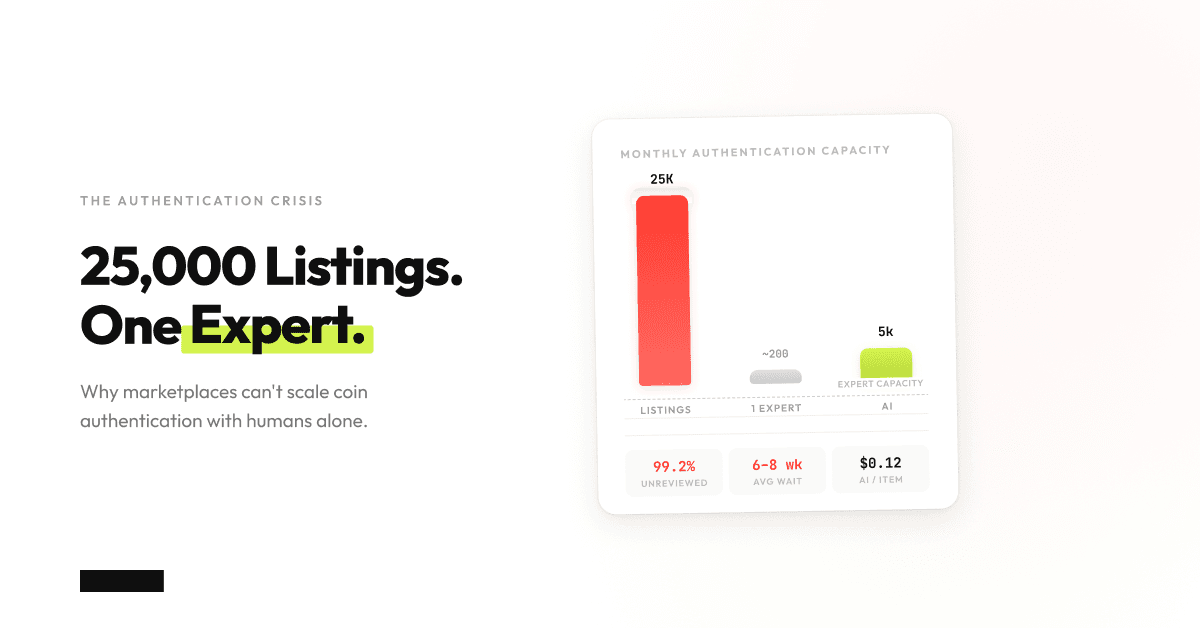
Your marketplace coin authentication team is underwater, and hiring more experts won't fix it.
The collectibles market is projected to reach $602.4 billion in 2026, with coins and currency among the fastest-growing segments. That growth is flooding online marketplaces with tens of thousands of new listings every month. Meanwhile, counterfeiters are leveling up: Red Points detected 4.3 million counterfeit product infringements online in 2024, a 15% year-over-year increase.
If you're a VP of Product or Head of Trust & Safety responsible for coin category integrity, you already feel this pressure. This article breaks down exactly why manual marketplace coin authentication fails at scale, what it costs when it does, and how the industry is rethinking authentication as infrastructure.
The Math That Breaks Every Marketplace Authentication Team
Authentication scalability isn't a people problem. It's an arithmetic problem.
A seasoned numismatic expert can thoroughly evaluate roughly 40-50 coins per day when performing detailed visual inspection, research, and documentation. At 50 coins per day and 22 working days per month, one expert covers 1,100 listings. To review 25,000 monthly listings, you need approximately 23 full-time specialists working at capacity every single day.
Here's where the unit economics collapse:
Specialist salaries: Experienced coin graders earn $100,000+ annually, per NGC career data. A team of 23 costs $2.3M+ in salary alone before benefits, training, and management overhead.
Industry benchmarks: Marketplaces spend $25-30M per category on manual authentication teams when you factor in the full cost of hiring, tooling, quality assurance, and dispute resolution.
Processing time: Third-party grading services like PCGS and NGC, designed for thorough individual assessment, offer turnaround times of 20-65 business days per coin depending on service tier, according to PCGS turnaround statistics. That thoroughness creates weeks to months of latency before a listing is verified.
Those numbers assume perfect conditions: no sick days, no turnover, no training ramp, and no surge periods. In reality, the gap between listing volume and review capacity only widens.
What Counterfeit Coin Listings Actually Cost Your Marketplace
Counterfeit coin detection isn't just a quality issue. It's a direct threat to your marketplace's revenue and reputation.
The data paints a stark picture:
Entrupy's 2024 State of the Fake Report found that nearly 9% of authenticated items across collectible categories failed authentication, up 0.8% from the prior year. Both counterfeit quality and quantity are increasing.
eBay hosts over 2.1 million coin listings at any given time, with community members reporting that thousands of counterfeits slip through monthly.
StockX reported rejecting 370,000+ products worth nearly $74 million in 2024 for failing verification standards across its collectibles categories, proving that even well-funded authentication programs face massive counterfeit volume.
RareCoin.store reports that gold coin counterfeits in 2026 use increasingly sophisticated alloys and techniques, making visual detection harder even for experts.
Every counterfeit that reaches a buyer triggers a cascade of costs you can quantify: refund processing, customer support tickets, shipping both ways, and potential chargeback fees. But the costs you can't easily quantify are worse.
According to Besedo's marketplace research, more than 58% of marketplace users have encountered misleading or fraudulent listings. Three-quarters of consumers consider trust a pivotal factor in choosing an ecommerce platform, per PYMNTS. And customers who experience fraud are far less likely to return or save payment details, directly harming lifetime value.
For a marketplace spending $25-30M per category on authentication, even a 2-3% counterfeit slip rate represents millions in downstream costs. The real question isn't whether you can afford better authentication infrastructure. It's whether you can afford not to have it.
Why Traditional Coin Authentication Can't Scale
Traditional coin authentication services like PCGS and NGC were designed for thorough, individual collector submissions. That model delivers expert-level accuracy but was not built for the speed that high-volume marketplace commerce demands.
Turnaround reflects thoroughness, not marketplace speed: PCGS charges $23-$75 per coin depending on service tier, with turnaround times ranging from 5 to 65 business days. NGC operates on a similar schedule. Premium "WalkThrough" services offer 3-5 day turnaround at $300+ per coin. These timelines reflect the depth of expert analysis involved, but at marketplace scale, they create a throughput gap.
The expert pipeline is narrow: Becoming a qualified coin grader requires years of hands-on training. The typical Professional Numismatists Guild member has 25+ years of experience. You cannot spin up a team of expert graders the way you'd hire a cohort of customer service agents. The coin grading turnaround time problem isn't just about current capacity; it's about how slowly that capacity can grow.
Per-coin costs don't scale: Sending 25,000 coins per month through third-party grading at even the economy tier ($23/coin) would cost $575,000 monthly, or $6.9M annually, for a single marketplace category, with turnaround times of 20-60 business days reflecting the thoroughness of expert evaluation.
Approach | Cost Per Coin | Turnaround | Monthly Cost (25K listings) |
|---|---|---|---|
Grading Body A | $23 | 20-60 days | $575,000 |
Grading Body B | $40 | 10-32 days | $1,000,000 |
NGC WalkThrough | $300+ | 3-5 days | $7,500,000+ |
In-house team (23 FTEs) | ~$8-10 | Same day | $190,000+ |
Even building an in-house system from scratch costs $1-3M and takes 1-2 years to reach production quality for a single category. The traditional model hits a ceiling well before marketplace volume demands, whether outsourced or in-house.
The Listing Hygiene Gap: What Happens When Reviews Can't Keep Up
When your trust and safety marketplace team can't keep pace with listing volume, the result isn't just missed counterfeits. It's a systematic breakdown in coin listing verification that affects every stakeholder.
Reactive enforcement replaces proactive screening: Instead of verifying listings before they go live, teams shift to takedown mode, removing fraudulent listings only after buyer complaints. eBay community forums are filled with reports of counterfeit coins that were listed and sold before anyone flagged them. Enforcement becomes a "game of whack-a-mole" where sellers are shut down only after multiple complaints.
Quality standards become inconsistent: Under volume pressure, review depth varies by reviewer, time of day, and backlog status. The same coin type might pass review on Monday and get flagged on Thursday, creating unpredictable seller experiences and eroding confidence in your platform's standards.
SLA commitments slip: If your platform promises listing approval within a certain timeframe, authentication backlogs force a choice: approve listings faster with less scrutiny, or miss your SLA. Neither option protects your marketplace.
Estate and collection dumps create surge events: When large estate coin collections hit your platform, you can see hundreds or thousands of listings from a single consignor in days. Manual teams can't flex to absorb these surges without sacrificing quality elsewhere.
The listing hygiene gap compounds over time. Every unverified listing that generates a bad buyer experience makes your next customer acquisition slightly more expensive. Every missed counterfeit gives sophisticated fraud operations data on what your systems miss.
Want to understand the full cost picture? Read our breakdown of why manual authentication is breaking marketplace budgets for a deeper dive into the $25-30M per-category spend.
How Marketplaces Are Rethinking Coin Authentication Infrastructure
The shift happening across high-volume marketplaces isn't about finding better experts. It's about treating online coin authentication as infrastructure rather than a manual craft.
The counterfeit coin detection market itself is growing at a 5.6% CAGR through 2031, driven by rising demand for scalable authentication solutions. The model emerging across the industry follows a layered approach:
Automated triage at listing time: Instead of reviewing every coin after it's listed, AI-powered ingestion engines analyze listing photos and metadata at the point of submission. Purpose-built category models, trained on datasets of 300M+ unique items, can assess authenticity, condition, and key identifiers like mint marks and die varieties in seconds rather than weeks.
Accuracy that rivals expert review: The best deep category models now achieve 97-99% authentication accuracy by analyzing the specific visual signatures that matter for each coin type: strike quality, luster patterns, surface characteristics, and known counterfeit markers. This isn't generic image recognition; it's production-grade AI built for numismatic analysis. The world's first dedicated coin category model is already live and in customers' hands.
Expert review for edge cases, not every listing: Automated triage doesn't replace human expertise. It redirects it. When the system flags a coin as ambiguous or high-risk, it routes to a human specialist with pre-analyzed data. Your experts spend their time on the 3-5% of listings that genuinely need a trained eye, not the 95% that are straightforward.
API infrastructure for seamless integration: Modern authentication layers plug into marketplace listing flows via API, similar to how Stripe handles payments. Listings get authenticated inline during the submission process, with no separate workflow, no mailing coins, and no multi-week wait. The compounding data flywheel means these systems get smarter with every item processed.
For the category gatekeeper evaluating whether to build or buy: building an in-house AI authentication system costs $1-3M per category and takes 1-2 years to reach production accuracy. Purpose-built API infrastructure lets you skip that timeline entirely.
Curious how it works under the hood? See our walkthrough of the AI workflow for coin analysis, from photo to authentication.
Frequently Asked Questions
How do marketplaces currently handle coin authentication at scale?
Most large marketplaces rely on a combination of in-house specialist teams and reactive community reporting. Specialists manually review flagged or high-value listings, while lower-value items often go live with minimal verification. This creates significant gaps in coverage, especially during volume surges, and drives the $25-30M per-category cost that most marketplace operators report for manual authentication programs.
What makes counterfeit coins so difficult to detect in online listings?
Modern counterfeits use increasingly sophisticated techniques, including precision alloys, accurate die reproductions, and even fake certification slabs. According to RareCoin.store, 2026 counterfeits are harder to spot because forgers now replicate weight, dimensions, and surface appearance with higher fidelity. In an online environment where buyers rely on photos rather than physical examination, traditional detection methods like density tests or ping tests are impossible.
Can AI authentication fully replace human coin experts?
No, and that's not the goal. AI-powered authentication infrastructure is designed to augment human expertise, not replace it. Automated systems handle the high-volume triage, identifying the 95%+ of listings that are clearly authentic or clearly problematic. Human experts then focus on edge cases, complex attributions, and high-value items where nuanced judgment matters. This layered approach improves both throughput and accuracy compared to all-manual or all-automated systems.
What does it cost to build an in-house coin authentication system?
Building a production-quality authentication system for a single collectible category typically costs $1-3M in development and takes 1-2 years to reach reliable accuracy. That investment covers model training, dataset acquisition, integration engineering, and ongoing quality calibration. For marketplaces that need to scale across multiple categories (coins, trading cards, handbags), the costs multiply. API-based authentication infrastructure offers an alternative that eliminates this upfront investment.
Written by
Ben Parfitt
Want to see Vardera in action?