Morgan Silver Dollar Values by Year, Mint Mark & Condition

Written by
Derek Bugley
A Morgan Silver Dollar sitting in a drawer could be worth $40 or $400,000. The difference comes down to three things: when it was minted, where it was minted, and the condition it survived in. Morgan dollars are the most collected U.S. coin series, with over 657 million struck between 1878 and 1921 across five different mints, and their morgan silver dollar value ranges are as wide as any coin in American numismatics.
This guide gives you the complete pricing reference: every year, every mint mark, every condition grade. You will also learn what drives those prices, which dates to watch for, and how modern AI valuation technology is making the entire lookup process instant. If you are working through a collection or evaluating a single coin, start with the price table below. For the full picture of how AI is transforming coin grading and valuation, see our complete guide to AI coin grading. And if you have coins beyond Morgans, our general coin valuation methodology covers the framework for any series.
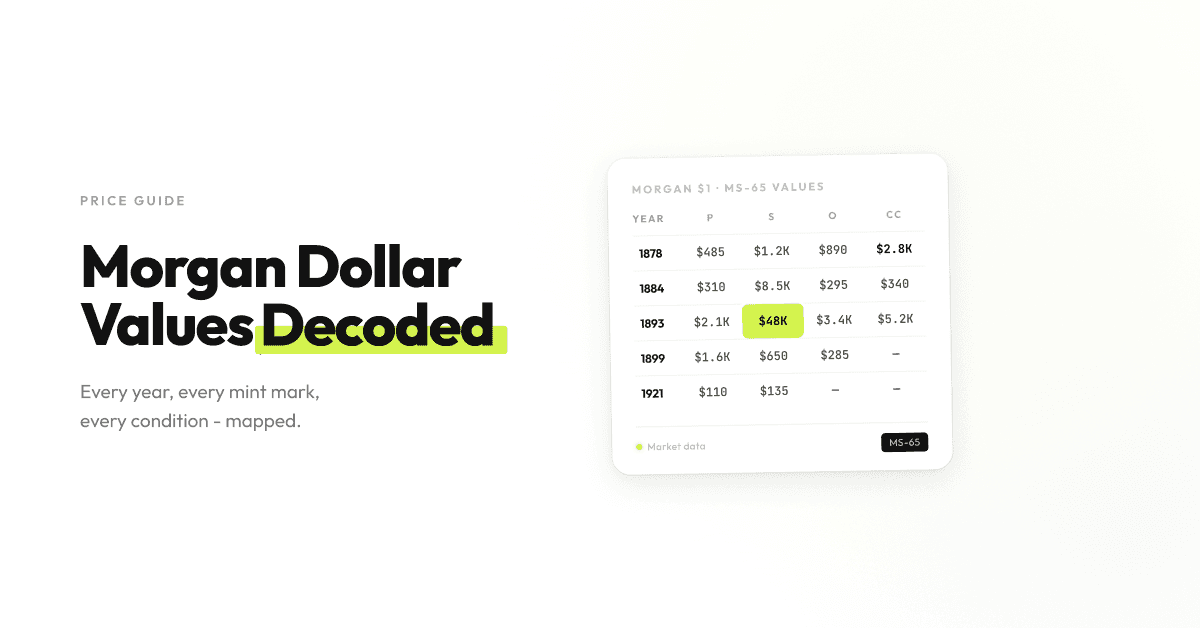
Quick Value Lookup: Morgan Silver Dollar Price Table
This is what you came for. The morgan silver dollar value chart below covers every year and mint mark combination for the series, with values across four condition tiers. Prices reflect recent dealer and auction data as of early 2026.
Before you scan the table, a few notes on how to use it. Key dates (the coins worth significantly more than common issues) are marked with an asterisk (*). Prices are approximate ranges based on current market conditions. For coins in exceptional condition (MS65 and above), values can be substantially higher than the uncirculated column shows, particularly for scarce dates.
The current silver melt value of a Morgan dollar is approximately $60 to $64, based on a silver spot price of roughly $78 to $82 per ounce and the coin's 0.7734 troy ounces of pure silver content. Common-date, heavily worn Morgans trade near this melt value floor.
How to Read This Table
Condition grades:
Good (G4-6): Heavy wear, major design elements visible but flat. The lowest collectible grade.
Fine (F12-15): Moderate wear with clear features. Liberty's hair shows some detail; eagle feathers partially defined.
Extremely Fine (EF40-45): Light wear on the highest points only. Hair above Liberty's ear shows detail; eagle's breast feathers are sharp.
Uncirculated (MS60-65): No wear. Ranges from MS60 (bag marks, less eye appeal) to MS65 (gem quality, strong luster).
Mint marks:
(P) Philadelphia (no mint mark on the coin)
(O) New Orleans
(S) San Francisco
(CC) Carson City
(D) Denver (1921 only)
Year | Mint | Good | Fine | EF | Uncirculated (MS60-65) | Notes |
|---|---|---|---|---|---|---|
1878 | P (8TF) | $75 | $110 | $165 | $250-700 | 8 tail feather variety |
1878 | P (7TF) | $55 | $70 | $90 | $150-500 | 7 tail feather, more common |
1878 | CC* | $110 | $175 | $250 | $325-1,500 | First year CC Morgan |
1878 | S | $45 | $55 | $75 | $120-400 | |
1879 | P | $40 | $48 | $60 | $80-350 | |
1879 | CC* | $200 | $350 | $600 | $1,200-5,900 | Scarce; Rev of '78 variety worth more |
1879 | O | $40 | $48 | $65 | $100-500 | |
1879 | S | $40 | $48 | $60 | $80-350 | |
1880 | P | $40 | $48 | $60 | $80-350 | |
1880 | CC | $165 | $200 | $250 | $350-1,200 | |
1880 | O | $40 | $50 | $70 | $100-500 | |
1880 | S | $40 | $48 | $60 | $75-300 | Common in high grade |
1881 | P | $40 | $48 | $60 | $80-350 | |
1881 | CC* | $325 | $340 | $380 | $560-2,000 | |
1881 | O | $40 | $48 | $60 | $80-400 | |
1881 | S | $40 | $48 | $55 | $70-250 | Very common in MS |
1882 | P | $40 | $48 | $60 | $80-350 | |
1882 | CC | $110 | $130 | $160 | $250-900 | |
1882 | O | $40 | $48 | $60 | $80-400 | |
1882 | S | $40 | $48 | $55 | $70-250 | Very common in MS |
1883 | P | $40 | $48 | $60 | $80-350 | |
1883 | CC | $110 | $130 | $160 | $250-900 | |
1883 | O | $40 | $48 | $60 | $75-300 | |
1883 | S | $42 | $65 | $150 | $500-8,000 | |
1884 | P | $40 | $48 | $60 | $80-350 | |
1884 | CC | $150 | $175 | $210 | $300-1,200 | |
1884 | O | $40 | $48 | $60 | $75-300 | |
1884 | S* | $40 | $60 | $300 | $8,500-32,000 | Huge grade cliff |
1885 | P | $40 | $48 | $60 | $80-300 | |
1885 | CC* | $440 | $500 | $575 | $700-2,500 | Low mintage CC |
1885 | O | $40 | $48 | $55 | $70-250 | |
1885 | S | $42 | $55 | $100 | $250-2,000 | |
1886 | P | $40 | $48 | $60 | $75-300 | |
1886 | O* | $42 | $80 | $350 | $2,500-25,000 | Scarce in high grade |
1886 | S | $55 | $80 | $130 | $250-1,500 | |
1887 | P | $40 | $48 | $60 | $75-300 | |
1887 | O | $40 | $48 | $65 | $100-500 | |
1887 | S | $42 | $55 | $80 | $150-800 | |
1888 | P | $40 | $48 | $60 | $80-350 | |
1888 | O | $40 | $48 | $60 | $80-350 | |
1888 | S | $55 | $80 | $130 | $250-1,200 | |
1889 | P | $40 | $48 | $60 | $80-350 | |
1889 | CC* | $950 | $1,650 | $4,500 | $22,000-40,000+ | One of the top rarities |
1889 | O | $40 | $48 | $65 | $200-2,000 | |
1889 | S | $42 | $55 | $80 | $150-800 | |
1890 | P | $40 | $48 | $60 | $80-400 | |
1890 | CC | $100 | $130 | $200 | $400-2,500 | |
1890 | O | $40 | $48 | $65 | $120-700 | |
1890 | S | $40 | $48 | $65 | $100-500 | |
1891 | P | $40 | $48 | $65 | $100-500 | |
1891 | CC | $100 | $135 | $210 | $450-2,800 | |
1891 | O | $40 | $50 | $80 | $200-2,000 | |
1891 | S | $40 | $48 | $65 | $100-500 | |
1892 | P | $42 | $55 | $100 | $250-1,500 | |
1892 | CC | $150 | $250 | $475 | $1,200-6,000 | |
1892 | O | $42 | $55 | $80 | $200-2,500 | |
1892 | S* | $70 | $120 | $2,500 | $50,000-93,000 | Major rarity in high grade |
1893 | P | $150 | $250 | $425 | $1,200-5,000 | |
1893 | CC* | $220 | $500 | $1,200 | $5,000-25,000 | Low mintage |
1893 | O* | $120 | $275 | $700 | $5,000-30,000 | |
1893 | S* | $4,000 | $7,000 | $12,500 | $190,000-300,000+ | The king of Morgans |
1894 | P* | $525 | $1,000 | $2,000 | $5,000-20,000 | |
1894 | O | $50 | $80 | $200 | $700-5,000 | |
1894 | S | $55 | $100 | $250 | $700-4,000 | |
1895 | P* | — | — | — | $50,000-175,000 | Proof only; no business strikes |
1895 | O | $150 | $400 | $2,000 | $15,000-50,000 | |
1895 | S | $120 | $300 | $1,000 | $3,500-25,000 | |
1896 | P | $40 | $48 | $60 | $80-350 | |
1896 | O* | $42 | $80 | $500 | $5,000-30,000 | Rare in MS |
1896 | S | $55 | $120 | $500 | $2,000-10,000 | |
1897 | P | $40 | $48 | $60 | $80-350 | |
1897 | O | $42 | $55 | $100 | $500-5,000 | |
1897 | S | $40 | $48 | $65 | $100-500 | |
1898 | P | $40 | $48 | $60 | $80-350 | |
1898 | O | $40 | $48 | $55 | $70-250 | |
1898 | S | $50 | $80 | $180 | $500-3,000 | |
1899 | P | $100 | $150 | $200 | $300-1,000 | Low mintage Philly |
1899 | O | $40 | $48 | $55 | $70-250 | |
1899 | S | $50 | $70 | $130 | $300-2,000 | |
1900 | P | $40 | $48 | $60 | $80-350 | |
1900 | O | $40 | $48 | $55 | $70-300 | |
1900 | S | $42 | $60 | $120 | $300-2,500 | |
1901 | P* | $55 | $100 | $400 | $10,000-50,000+ | Rare in MS |
1901 | O | $40 | $48 | $55 | $70-250 | |
1901 | S | $50 | $80 | $150 | $400-3,000 | |
1902 | P | $42 | $55 | $80 | $150-800 | |
1902 | O | $40 | $48 | $55 | $70-250 | |
1902 | S | $55 | $100 | $200 | $600-3,500 | |
1903 | P | $42 | $55 | $80 | $120-500 | |
1903 | O* | $300 | $320 | $340 | $375-1,000 | Value spike in MS |
1903 | S | $85 | $200 | $1,500 | $10,000-50,000 | |
1904 | P | $42 | $55 | $85 | $150-800 | |
1904 | O | $40 | $48 | $60 | $80-350 | |
1904 | S | $55 | $100 | $250 | $800-5,000 | Last pre-hiatus year |
1921 | P | $35 | $38 | $42 | $50-200 | Highest mintage (44.6M) |
1921 | D | $35 | $38 | $42 | $50-200 | Denver's only Morgan |
1921 | S | $35 | $38 | $42 | $50-200 |
Asterisk () indicates key dates. Prices are approximate ranges based on recent market data and may vary by eye appeal, toning, and specific grade within each tier. Melt value floor: approximately $60-64 at current silver prices (~$78-82/oz).*
What Makes a Morgan Silver Dollar Valuable?
Four factors determine what a Morgan silver dollar is worth. Understanding them turns the price table above from a wall of numbers into a tool you can actually use.
The same coin from the same year can be worth $40 at one mint and $4,000 at another. The same date and mint combination can be worth $50 in one condition and $50,000 in another. These factors interact, and that interaction is what makes Morgan dollar valuation both fascinating and complex.
Date and Rarity: Key Dates vs. Common Dates
Not all years are created equal. Original mintage tells you how many coins the Mint produced. Surviving population, tracked by PCGS and NGC population reports, tells you how many actually exist today in each grade. That surviving number is what drives morgan dollar prices.
Key dates (the coins collectors chase):
1893-S: Only 100,000 minted. The undisputed king of the Morgan series. Values start around $4,000 in Good and reach into the hundreds of thousands in uncirculated grades. The finest known example, graded MS-67 by NGC, sold for $2,086,875 at GreatCollections in 2021.
1889-CC: Just 350,000 struck at Carson City. Circulated examples start around $950, and uncirculated coins quickly enter five-figure territory.
1895 Philadelphia: The "King of Morgan Proofs." No business strikes have been confirmed. Only proof examples exist, valued from $50,000 to $175,000 depending on grade.
1879-CC: The reverse of 1878 variety is particularly scarce, ranging from $200 in Good to nearly $6,000 in Mint State.
1893-CC, 1884-S, 1892-S: All low-mintage or low-survival issues that command strong premiums, especially in higher grades.
Common dates (affordable entry points):
1921: The most common Morgan year by a wide margin, with over 86 million produced across three mints. Circulated examples start at $35 to $40, essentially silver melt value plus a modest numismatic premium.
1881-S, 1882-S, 1880-S: Available in large quantities including uncirculated, making them popular starter coins for new collectors.
Semi-key dates worth knowing: 1878-CC, 1890-CC, 1883-CC, and 1885-CC. These carry Carson City premiums but at more accessible price points than the true key dates.
Mint Mark Impact on Value
Morgan silver dollar value by mint mark varies dramatically. The mint mark is often the single biggest value differentiator for a given date. The general scarcity hierarchy runs: CC > S > O > D > P, though there are significant exceptions for specific dates.
Carson City (CC) commands the highest premiums. Low total mintages (the Carson City Mint was the smallest facility), combined with strong Old West collector appeal and limited survival rates, create consistent premiums. Even common-date CC Morgans in circulated condition typically start around $100 to $150. According to Xenia Coin Shop's 2026 dealer guide, Carson City coins rank among the most sought-after in the entire series.
San Francisco (S) produced many of the series' greatest rarities (1893-S, 1892-S, 1895-S) and generally struck coins with sharper detail than other mints.
New Orleans (O) coins are often available in lower grades but can be extremely scarce in mint state. The 1886-O and 1896-O, for example, are common in circulated grades but extremely rare uncirculated.
Denver (D) only produced Morgans in 1921, making the 1921-D a one-year issue, though its high mintage keeps prices modest.
Where to find the mint mark: On the reverse (back) of the coin, above the letters "DO" in "DOLLAR," nestled between the eagle's tail feathers and the wreath bow. Philadelphia coins have no mint mark.
Condition and Grade: Why It Matters More Than You Think
Condition is where morgan silver dollar worth multiplies exponentially. The same coin in different grades can differ by 10x, 100x, or more.
The Sheldon scale (1-70) is the industry standard. For practical purposes, Morgan dollar values cluster around four major grade tiers: Good (G4-6), Fine (F12-15), Extremely Fine (EF40-45), and Mint State (MS60-65+).
The grade cliff is real: Take the 1884-S: worth roughly $40 in Good, $60 in Fine, $300 in Extremely Fine, and $8,500 to $32,000 uncirculated. That jump from EF to MS is not a gentle slope. It is a cliff, and it is the reason condition assessment matters more than any other single factor for Morgan dollar valuation.
Key wear points on Morgan dollars (what to examine when assessing condition):
Liberty's cheek and hair above the ear: These high-relief areas show wear first. A coin with sharp hair detail above the ear is in better condition than one where these strands have flattened.
Eagle's breast feathers: Check the center of the eagle on the reverse. Defined, separated feathers indicate higher grades.
Wing tips: The tops of the eagle's wings lose detail with circulation.
Field surfaces: Look for contact marks (bag marks), scratches, and hairlines under good lighting. These reduce the grade even on technically unworn coins.
The AU to MS jump: The difference between About Uncirculated (AU50-58) and Mint State (MS60+) can represent a 2x to 5x price difference. An AU coin has just the faintest trace of wear on the highest points. An MS coin has none. At a glance, they can look identical, but the market pays a substantial premium for that distinction.
Professional grading services like PCGS and NGC assign precise Sheldon grades (1-70), encapsulate the coin in a tamper-evident holder, and guarantee authenticity. Fees range from $22 to $150+ per coin depending on the service tier, with turnaround times from weeks to months. For a detailed cost breakdown and comparison, see how AI compares to PCGS and NGC.
Silver Price and Market Forces
Every Morgan dollar has a floor value determined by its silver content. At current silver prices of approximately $78 to $82 per ounce (as of early 2026, per Coinflation), the melt value of a Morgan dollar is roughly $60 to $64.
When melt value matters: For common-date, heavily circulated coins where the numismatic premium is thin. A 1921 Morgan in Good condition trades near melt value because tens of millions survive. The silver content is the primary value driver for these coins.
When melt value is irrelevant: For key dates and high-grade coins, the collector premium far exceeds the metal content. Nobody buying a $190,000 1893-S in MS65 is thinking about $60 worth of silver.
2021/2023/2025 US Mint restrikes and market impact: The US Mint began striking new Morgan dollars in 2021 to commemorate the 100th anniversary of the original series' final year. According to NGC, the 2021 release stimulated increased demand for vintage 1878-1921 originals, introducing a wave of new collectors to the series. The 2023 and 2025 releases continued with limited mintages (2025 capped at just 150,000 coins for the Philadelphia issue). These modern restrikes trade at premiums above their issue prices but are distinct from and generally less valuable than original-era Morgans in comparable condition.
Morgan Silver Dollar Values by Year: Detailed Breakdown
The price table gives you the numbers. This section gives you the context to understand why specific dates and mint combinations matter. When working through a collection, these are the coins to pay closest attention to.
1878-1882: The Early Morgan Dollars
The series launched in 1878 after the passage of the Bland-Allison Act, which required the U.S. Treasury to purchase large quantities of silver for coinage. The first year is notable for its varieties: the original 8 tail feather design was quickly modified to 7 tail feathers, and transitional 7/8 overdate varieties exist as well. All three varieties carry premiums over later common dates.
Carson City coins from this era (1878-CC through 1882-CC) carry consistent premiums. The 1879-CC is the standout, particularly the Reverse of 1878 variety, which is recognized as a key date. Even the more common CC issues from 1880 to 1882 typically start around $110 to $165 in Good condition.
San Francisco and New Orleans coins from these years are generally available at near-common-date prices in circulated grades, though specific dates like the 1880-O can be scarce in higher grades.
1883-1889: Peak Production and Key Rarities
This era includes some of the most dramatic value contrasts in the series.
Carson City highlights: The 1884-CC and 1885-CC had low original mintages (1.1 million and 228,000 respectively). Large quantities of both dates were stored in U.S. Treasury vaults for decades. In the 1960s, approximately 2.5 million Carson City Morgans were discovered in the vaults, and the General Services Administration (GSA) sold them to the public through a series of sales from 1972 to 1980. These GSA sales generated roughly $100 million and made uncirculated examples of certain CC dates (particularly 1882-CC, 1883-CC, and 1884-CC) more available than their low mintages would suggest. The 1885-CC starts around $440 in Good and reaches $2,500 in uncirculated.
1889-CC: This is one of the series' top rarities. Only 350,000 were minted, and survival rates are low. Circulated examples start around $950 and uncirculated coins enter the $22,000 to $40,000+ range. It is the third most valuable Morgan in the series behind only the 1893-S and 1895 Proof.
Philadelphia overproduction: The Philadelphia Mint produced massive quantities during these years (25 to 35 million annually in some years), making most P-mint coins from this era very affordable.
1890-1904: Final Run and the Great Rarities
This is where the series' greatest rarities live.
1893-S: The King of Morgan Dollars. The San Francisco Mint produced just 100,000 coins, the lowest business-strike mintage in the entire series. In Good condition, expect to pay around $4,000. In Fine, approximately $7,000. The finest known example, graded MS-67 by NGC, sold for $2,086,875 at auction in 2021. Even mid-grade uncirculated examples ($190,000 to $300,000+) are museum-caliber coins.
1895 Philadelphia: The "King of Morgan Proofs." No business strike examples have been definitively confirmed to exist, despite an official mintage record of 12,000. Only proof examples survive, valued from $50,000 to $175,000 depending on grade.
1892-S and 1893-CC: Both are major rarities, particularly in higher grades. The 1892-S shows one of the most extreme grade cliffs in the series: $70 in Good, $120 in Fine, $2,500 in EF, and $50,000 to $93,000 uncirculated.
Why production stopped after 1904: Silver reserves purchased under the Bland-Allison Act and Sherman Silver Purchase Act were exhausted, and the Mint had no mandate to continue production. In 1918, the Pittman Act authorized the melting of approximately 270 million silver dollars to provide silver bullion for wartime needs, destroying a substantial portion of the surviving Morgan dollar population. Only about 17% of all Morgans minted are estimated to survive today. Production resumed briefly in 1921 before the series was replaced by the Peace dollar.
1921: The Last (and Most Common) Morgan Dollar
After a 17-year hiatus, the Mint struck Morgans again in 1921, producing over 86 million coins across Philadelphia (44.6 million), Denver (20.3 million), and San Francisco (21.7 million). These are the most commonly encountered Morgan dollars by a wide margin.
1921 morgan silver dollar value profile: Circulated examples start at $35 to $40, essentially silver melt value with a modest premium. Uncirculated examples range from $50 for an MS60 to $200 or more in MS65, making them the most affordable entry point for collectors building a Morgan dollar set.
Why 1921 Morgans look different: The original Morgan dollar dies were destroyed years earlier. New hubs had to be created, resulting in a shallower, less detailed strike compared to earlier issues. Experienced collectors can spot a 1921 Morgan at a glance because the relief is noticeably flatter. This cosmetic difference doesn't significantly affect value at common grades, but high-grade 1921 examples with strong strikes can carry small premiums.
The 10 Most Valuable Morgan Silver Dollars
If you are checking whether you have a hidden treasure, or if you are an auction house specialist screening an estate lot, these are the coins to watch for. This ranked list covers the most valuable morgan silver dollars based on recent market values for high-grade examples.
Rank | Coin | Mintage | Value Range (Grade-Dependent) | Why It's Valuable |
|---|---|---|---|---|
1 | 1893-S | 100,000 | $4,000-$2,000,000+ | Lowest business-strike mintage; the definitive Morgan rarity |
2 | 1895 (Proof) | 880 proofs | $50,000-$175,000 | No confirmed business strikes; proof-only issue |
3 | 1889-CC | 350,000 | $950-$1,200,000 | Extremely low survival rate from Carson City |
4 | 1884-S | 3,200,000 | $40-$1,250,000 | Common circulated, astronomically rare in MS65+ |
5 | 1893-CC | 677,000 | $220-$142,500 | Late Carson City with low mintage |
6 | 1892-S | 1,200,000 | $70-$93,000 | Dramatic grade cliff; near-impossible in gem MS |
7 | 1895-O | 450,000 | $150-$700,000 | Rare in all grades above Fine |
8 | 1886-O | 10,710,000 | $42-$141,000+ | High mintage but almost none survived in MS |
9 | 1894 (P) | 110,972 | $525-$125,000 | Low mintage Philadelphia |
10 | 1903-S | 1,241,000 | $85-$120,000 | Scarce in uncirculated |
Several of these coins illustrate a critical principle: mintage alone does not determine rarity. The 1886-O had over 10.7 million minted but is worth $141,000+ in top grades because almost none survived uncirculated. The 1884-S was minted in the millions but is worth over a million dollars in MS65+ because virtually all circulated heavily. Surviving population, not original production, drives value.
How to Determine Your Morgan Silver Dollar's Value
You have the price table. You understand the four value drivers. Now here is a practical step-by-step method to value any Morgan dollar in your hands.
Traditional Valuation Methods (and Their Limits)
Step 1: Identify the date and mint mark. The date is on the obverse (front) below Liberty's portrait. The mint mark is on the reverse, above the "DO" in "DOLLAR." No mint mark means Philadelphia.
Step 2: Assess condition. Compare your coin against the wear points described above (Liberty's cheek, hair above ear, eagle's breast feathers). Use free reference photos from PCGS Photograde or NGC's grading standards to estimate a grade range.
Step 3: Check current market prices. Cross-reference with the PCGS Price Guide, NGC Price Guide, or recent auction results on Heritage Auctions.
Step 4: Consider professional grading. If your research suggests the coin may be worth $200 or more graded, PCGS or NGC certification makes economic sense. The certification adds market value through authentication, precise grading, and tamper-evident encapsulation.
The limitation with this traditional approach is time. Each coin takes 15 to 30 minutes to research properly. For a single coin, that is fine. For an estate lot of 50 or 100 Morgans, it is a weeks-long project. And for an auction house specialist with a consignment backlog stretching into next quarter, it is unsustainable. Large online marketplaces spend $25 to $30 million per category on manual authentication and valuation teams, and still can't keep pace with volume.
AI-Powered Morgan Dollar Valuation
This is where the manual lookup process you have been doing gets compressed from minutes per coin to seconds.
AI computer vision models analyze the same features human graders assess: surface preservation, luster patterns, strike quality, contact marks, and mint mark characteristics. The difference is speed and scale. A production AI system processes a coin image and returns identification, grade estimate, and market valuation in seconds, not the minutes or hours that manual research requires.
For Morgan dollar valuation specifically, AI is particularly well-suited to the triage problem. You have 50 Morgans from an estate. Some are common-date 1921s worth $35 each. A few might be Carson City issues worth $500+. One could be a key date worth thousands. AI screens the entire lot in minutes, telling you which coins deserve closer attention, which are worth sending to PCGS or NGC for certification, and which are straightforward bullion-value pieces.
Vardera's coin category model, the world's first production AI coin model, achieves 97-99% authentication accuracy and delivers results in seconds, trained on a proprietary dataset of over 200 million unique items. It analyzes the same domain-specific features that experienced graders evaluate: mint marks, die characteristics, casting variances, and surface conditions. The model is live and in production with real customers, not a prototype.
When to use each method:
Single valuable coin (potentially $500+): Professional PCGS or NGC certification for the market credential
Collection triage (10+ coins, unknown value): AI pre-screening to identify which coins justify the $30+ per coin PCGS/NGC fee
Quick check on a single coin: Price guide lookup using the table above
Buying, Selling, and Collecting Morgan Dollars
Understanding morgan dollar value by year is the first step. Knowing what to do next is where it becomes actionable.
Where to buy Morgan dollars:
Reputable dealers: Established coin dealers with return policies and documented inventory. Ask for PCGS or NGC certified coins when spending $200+.
Auction houses: Heritage Auctions, Stack's Bowers, and GreatCollections are the major venues for rare and high-grade Morgans. Competitive bidding often establishes true market value.
Online marketplaces: eBay has massive Morgan dollar inventory, but authentication risk is higher. Stick to certified coins or well-established sellers with strong feedback.
Where to sell:
Auction houses for rare pieces where competitive bidding maximizes value (10-20% seller's commission)
Dealers for common dates where speed and simplicity matter (expect 50-70% of retail value)
Online direct sales for the in-between pieces if you have listing and shipping experience
Building a collection:
Date set: One coin per year (1878-1904, 1921). A popular approach with achievable milestones.
Mint mark set: Every date and mint combination. A lifelong pursuit given the key dates.
Type set: One representative Morgan in the best grade you can afford. The simplest entry point.
Key date focus: Collecting the top rarities in the best affordable grades. An investment-oriented approach.
Red flags to watch for: Cleaned coins (unnatural brightness, hairlines visible under magnification), altered mint marks (a "D" or "S" added to a Philadelphia coin to fake a rarer variety), and outright counterfeits, especially on high-value dates. Morgan dollars are among the most counterfeited U.S. coins. For a deep dive into authentication, see our guide on how to detect counterfeit coins.
Frequently Asked Questions
How much is a Morgan silver dollar worth today?
Most Morgan silver dollars in circulated condition are worth $35 to $60, near their silver melt value of approximately $60 to $64 at current silver prices. Better dates and higher grades command significant premiums. Carson City mint marks add $100+ even for common years. Key dates like the 1893-S start at $4,000+ regardless of condition. The full price table above covers every date, mint, and grade combination.
What is the most valuable Morgan silver dollar?
The 1893-S Morgan Dollar is the most valuable business-strike issue, with values ranging from approximately $4,000 in Good condition to over $2 million for the finest known example. An MS-67 specimen sold for $2,086,875 at GreatCollections in 2021. The 1895 Philadelphia (proof only, no business strikes confirmed) and 1889-CC are the second and third most valuable.
Are all Morgan silver dollars silver?
Yes. Every genuine Morgan dollar contains 90% silver and 10% copper, with a total weight of 26.73 grams (0.8594 troy ounces). The pure silver content is 0.7734 troy ounces. At current silver spot prices of approximately $78 to $82 per ounce, the silver melt value is roughly $60 to $64 per coin.
How do I know if my Morgan silver dollar is real?
Start with basic physical tests: weigh the coin (should be 26.73 grams), apply a magnet (silver is non-magnetic), and examine details under magnification. For higher confidence, check against known genuine examples for correct die characteristics and surface quality. AI-powered authentication tools can flag potential counterfeits from photos in seconds. For high-value coins, PCGS or NGC certification provides a guarantee of authenticity. Morgan dollars are heavily counterfeited, especially key dates.
What is the difference between a Morgan and Peace dollar?
Morgan dollars (1878-1921) feature designer George T. Morgan's Liberty Head portrait on the obverse and a heraldic eagle on the reverse. Peace dollars (1921-1935) feature Anthony de Francisci's profile of Liberty wearing a radiate crown and a perched eagle on the reverse. The Peace dollar was designed to commemorate the end of World War I. Both contain 0.7734 troy ounces of silver, but they are separate series with different collector markets and value structures.
Is it worth getting a Morgan silver dollar graded?
It depends on the coin's potential value. Professional grading from PCGS or NGC costs $22 to $150+ per coin. A practical rule: if the graded value is likely at least 3x the all-in grading cost, certification makes economic sense. For common-date circulated Morgans worth $35 to $50, grading is not justified. For Carson City coins, key dates, or coins that appear uncirculated, the certification investment often adds more value than it costs. AI pre-screening can help identify which coins in a collection justify the grading fee.
How does AI grade Morgan silver dollars?
AI computer vision models analyze high-resolution coin images to evaluate the same features human graders assess: surface preservation, luster quality, strike sharpness, contact marks, and mint mark characteristics. The model maps these observations to Sheldon scale grade estimates with confidence levels. Production-grade systems like Vardera's coin model achieve 97-99% authentication accuracy by analyzing domain-specific features trained on over 200 million unique items.
Where is the mint mark on a Morgan silver dollar?
On the reverse (back) of the coin, above the letters "DO" in "DOLLAR," between the eagle's tail feathers and the wreath bow. Carson City coins show "CC," San Francisco shows "S," New Orleans shows "O," and Denver shows "D" (1921 only). Philadelphia coins have no mint mark. Use a magnifying glass if the area appears worn.
Written by
Derek Bugley
Want to see Vardera in action?