Rare Coin Identification: How AI Spots Error Coins, Varieties & Key Dates

Written by
Ben Parfitt
A 1943 Lincoln cent struck on a bronze planchet instead of steel sold for $840,000 at Heritage Auctions. The coin sat in a collection for decades before someone realized the mint had made a mistake. Stories like this are what make rare coin identification one of the most compelling pursuits in numismatics, and the error coin segment is now the fastest-growing in the collecting market at a 20.9% CAGR. The problem is that recognizing what makes a coin rare has traditionally required years of specialized knowledge, reference books, and an eye trained to catch details smaller than a grain of sand.
That is changing. Error coins, die varieties, and key dates are the three categories of coins hiding extraordinary value in plain sight, and this guide covers how to identify all three. You will learn what makes each category valuable, which specific coins to look for, how to tell the difference between a genuine error and worthless damage, and how AI computer vision is transforming rare coin identification by spotting anomalies that human eyes miss at scale.
For a broader look at how AI fits into the numismatic world, see our complete guide to AI coin grading and valuation.
The Three Categories of Rare Coins Hiding in Your Collection
Most collectors know that old coins can be valuable. Fewer realize there are three distinct reasons a coin might be worth far more than its face value, and each one requires a different identification approach.
Error coins are manufacturing mistakes at the mint. A planchet fed to the wrong press, a die that strikes off-center, or a doubled impression during the hubbing process. These are unintentional, often unique or produced in tiny quantities, and they create the dramatic visual anomalies that command the highest premiums.
Variety coins are die differences that produce batches of coins with distinct characteristics. A mint mark punched slightly off-position, a date re-engraved over a previous year, or a design hub that creates a "small date" versus a "large date." Varieties are produced consistently across a die's lifespan, creating groups of identical deviations rather than one-off accidents.
Key date coins are specific year-and-mint-mark combinations with unusually low mintage, high attrition, or extraordinary collector demand. Even heavily circulated examples of a key date can be worth hundreds or thousands of dollars.
The critical distinction: error, variety, and key date are not interchangeable terms. Each has different identification techniques, different value drivers, and different levels of difficulty to spot. Learning how to identify rare coins means learning to check for all three on every piece that crosses your path.
Error Coins: When the Mint Makes a Mistake
Error coins are the most dramatic category of rare coins and the most searched. They represent manufacturing mistakes at the United States Mint (or any world mint) where something went wrong during the production process. The results range from subtle to spectacular, and the values from a few dollars to six figures.
There are three main coin error types based on where in the minting process the mistake occurred: planchet errors, die errors, and strike errors. Understanding which category an error belongs to helps you assess both its rarity and its market value.
Before diving in, one skill matters more than any other for error coin collectors: distinguishing mint-made errors from post-mint damage (PMD). A coin that was dropped, scratched, or hit with a hammer after leaving the mint is worth nothing extra. A coin with the same visual appearance caused by a minting malfunction could be worth thousands. The difference often comes down to surface characteristics, metal flow patterns, and whether the anomaly is consistent with known minting processes.
Planchet Errors: Wrong Metal, Missing Metal, No Metal
Planchet errors occur before the coin is struck. The blank disc of metal (the planchet) is wrong, defective, or absent.
Wrong planchet errors are among the most valuable in numismatics. The most famous example: the 1943 copper Lincoln cent, struck on a leftover bronze planchet when the mint had switched to zinc-coated steel for the war effort. Only 20 to 30 authenticated examples are known to exist. Recent auction sales range from $240,000 for circulated examples to $840,000 for a mint-state 1943-D specimen. A 1944 steel Lincoln cent (the reverse scenario, where a steel planchet was used after the mint switched back to copper) commands similar premiums.
Clipped planchets occur when the blanking press overlaps a previously punched area, creating a coin with a curved missing section. The signature diagnostic is the "Blakesley Effect," a weak area of the rim directly opposite the clip, caused by reduced metal flow during the strike.
Blank planchets (unstruck coin blanks) that escaped the mint without being struck are collectible, with Type 2 blanks (those that went through the upsetting mill to create a raised rim) valued higher than Type 1 (flat, unfinished blanks).
Lamination errors happen when impurities or gas pockets in the planchet metal cause layers to peel or separate. These range from minor surface flaking to dramatic split planchets.
Die Errors: Doubled Dies, Die Cracks, and Die Clashes
Die errors originate in the die manufacturing or deterioration process and are among the most collected error types.
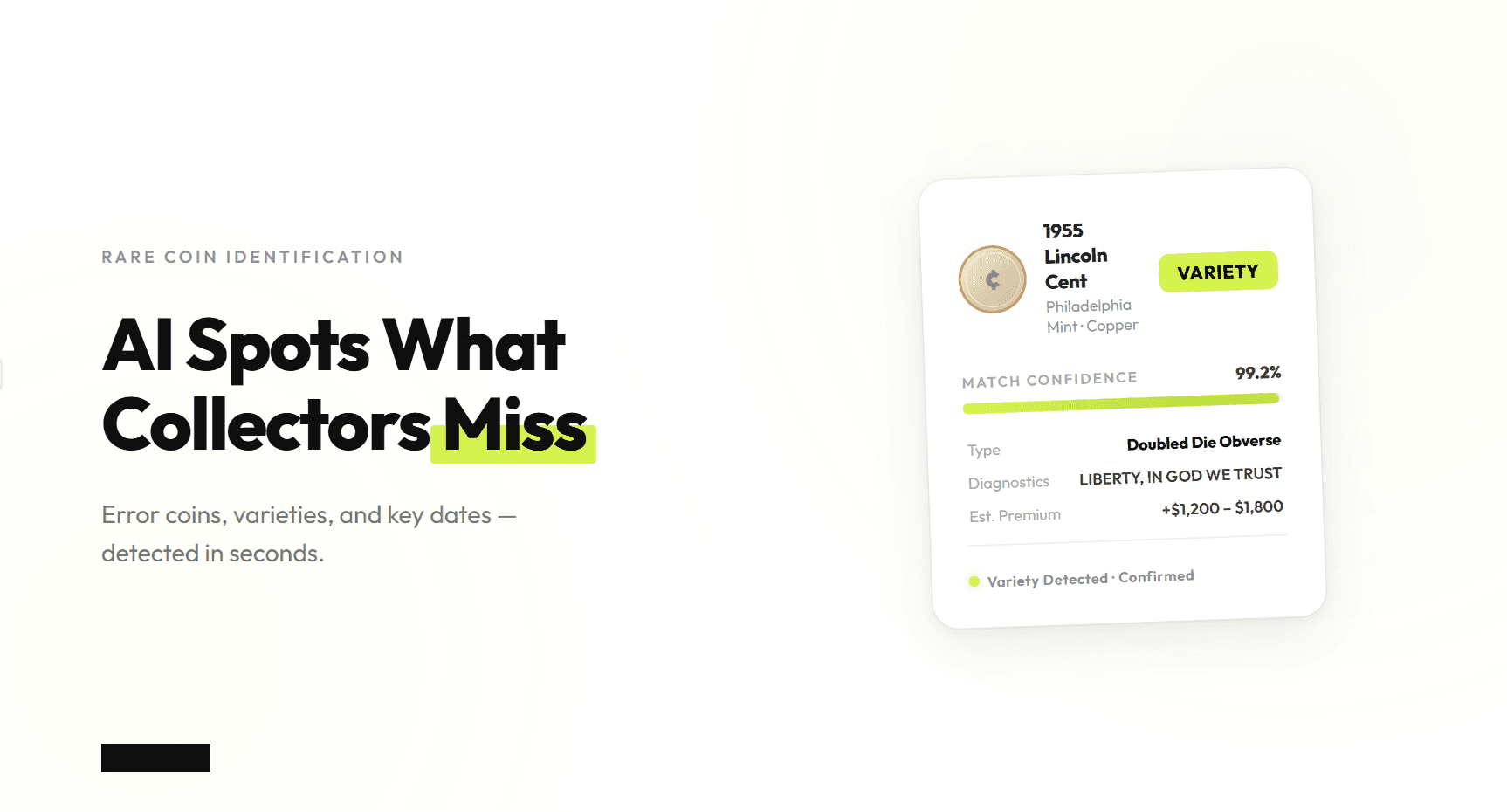
Doubled dies are the crown jewels of error collecting. Doubled die coins occur during the hubbing process when the die receives multiple impressions at slightly different angles, creating a coin with visibly doubled design elements. The 1955 doubled die obverse (DDO) Lincoln cent is the most famous example, with the doubling visible to the naked eye on "LIBERTY" and "IN GOD WE TRUST." Values range from $1,000 in lower grades to over $30,000 for mint state examples. The 1969-S DDO and 1972 DDO Lincoln cents are other major doubled die varieties worth $500 to $100,000 depending on condition.
One critical distinction separates valuable doubled dies from common worthless lookalikes: hub doubling versus machine doubling (MD). According to NGC's identification guide, true hub doubling shows rounded, separated profiles on design elements with clear separation between the serifs of all letters. Machine doubling, caused by die bounce during the striking process, produces flat, shelf-like displacement where the lettering appears smeared outward from the primary design. Machine-doubled coins add no collector value. This is the single most common misidentification in error collecting, and the source of more disappointed collectors than any other mistake.
Die cracks and cuds appear as raised lines or blobs on the coin's surface where the die itself has cracked or broken. Minor die cracks are common and add modest value. Major cuds, where a chunk of the die has broken away leaving a raised, featureless blob on the coin, can be worth considerably more.
Die clashes create ghost-like impressions when the obverse and reverse dies strike each other without a planchet between them. The resulting coins show faint, mirrored elements from the opposite die transferred into the design.
Strike Errors: Off-Center, Broadstrike, Multiple Strikes
Strike errors happen during the actual stamping process.
Off-center strikes occur when the planchet is not properly seated in the collar die before the strike. The percentage of offset determines value: a 5% off-center coin adds modest premium, while a 50% or greater off-center strike with a full, readable date can command hundreds to thousands of dollars. The date visibility is crucial. An off-center coin with no visible date is worth far less than one where the date survived the misalignment.
Broadstrikes result from a coin being struck without the collar die in place, allowing the metal to spread outward. The coin is larger than normal in diameter, with design elements that fade toward the rim.
Double and multiple strikes show two or more impressions, often with rotation between strikes. The visual effect is dramatic, with overlapping designs creating some of the most visually striking errors in numismatics.
Die caps and brockages are among the rarest strike errors. A die cap forms when a coin sticks to the upper die and is repeatedly struck into subsequent planchets, eventually cupping around the die like a bottle cap. Brockages occur when a previously struck coin sticks to a die and impresses its design into the next planchet, creating a mirror-image incuse impression.
The 10 Most Valuable Error Coins Worth Money
These are the error coins worth money that make headlines and fuel the treasure hunt:
Rank | Coin | Error Type | Estimated Value |
|---|---|---|---|
1 | 1943 Copper Lincoln Cent | Wrong planchet | $100,000+ |
2 | 1944 Steel Lincoln Cent | Wrong planchet | $75,000+ |
3 | 1975 No S Proof Roosevelt Dime | Missing mint mark | Up to $450,000 |
4 | 1969-S DDO Lincoln Cent | Doubled die | $25,000-$100,000+ |
5 | 1955 DDO Lincoln Cent | Doubled die | $1,000-$30,000+ |
6 | 2000-P Sacagawea/Quarter Mule | Wrong die pairing | $50,000+ |
7 | 1972 DDO Lincoln Cent | Doubled die | $500-$20,000+ |
8 | 1937-D 3-Legged Buffalo Nickel | Die polishing error | $500-$100,000+ |
9 | 1922 No D Lincoln Cent | Filled die (missing mint mark) | $500-$20,000+ |
10 | 2004-D Wisconsin Extra Leaf Quarter | Extra design element |
Notice the range from coins worth under $300 (the Wisconsin quarter, still findable in pocket change) to six-figure rarities. The 1943 copper cent and 1944 steel cent are wrong-planchet errors, the doubled dies dominate the mid-range, and the 2004 Wisconsin quarter proves that modern coins can still carry meaningful error premiums.
Coin Varieties: Subtle Die Differences That Create Big Value
If error coins are the fireworks of rare coin identification, varieties are the quiet undercurrent. They are harder to spot, less visually dramatic, and often more valuable per unit of collector effort because most dealers and collectors do not check for them.
A variety differs from an error in a fundamental way: varieties are produced consistently across a die's entire lifespan. When a die has a repunched mint mark, every coin struck from that die carries the same repunched mark. Errors are typically one-off accidents affecting individual coins. This distinction matters for both identification (varieties can be cross-referenced against known examples) and value (completists and registry set collectors need specific varieties to fill holes in their sets, creating sustained demand).
The standard reference for US coin varieties is the Cherrypickers' Guide to Rare Die Varieties, and attribution services like CONECA (Combined Organizations of Numismatic Error Collectors of America) maintain databases of cataloged varieties. Knowing these resources exist is the first step toward finding varieties others miss.
Overdates and Over Mint Marks
Overdates occur when a die engraved for one date is re-engraved with a different date, leaving traces of the original numerals visible beneath the new ones. The practice dates to an era when dies were expensive to produce and the mint economized by repurposing them.
The most famous overdate is the 1942/1 Mercury Dime, where the ghost of a "1" is clearly visible beneath the "2." Values range from approximately $400 in heavily circulated grades to $4,000 or more in mint state. Other notable overdates include the 1918/7-S Standing Liberty Quarter and the 1942/1-D Mercury Dime.
Over mint marks follow the same principle: a mint mark punched over a different mint mark. These are identified by traces of the original letter beneath the final mark.
Doubled Dies vs. Repunched Mint Marks (RPMs)
While doubled dies are classified as errors (see above), they are also tracked as varieties when the doubling appears consistently across coins from the same die. The distinction matters for how they are cataloged and collected.
Repunched mint marks (RPMs) occur when the mint mark was punched into the die at a slightly different position, creating a shadow or overlapping impression. Before 1990, mint marks on US coins were hand-punched into individual working dies, making RPMs relatively common across many series. Since 1990, mint marks have been included on the master die, eliminating new RPMs on modern coinage.
Key RPM varieties include numerous examples across Mercury Dimes, Lincoln Cents, and Buffalo Nickels, many cataloged by CONECA and valued from $10 to several hundred dollars.
Hub Varieties and Design Differences
Hub varieties are some of the most accessible for new collectors to identify because they involve differences visible without high magnification.
Small date versus large date varieties appear when the mint used different sized numeral hubs within the same year. The 1970-S Lincoln Cent small date variety is worth $35 to $50 or more, versus approximately $0.10 for the common large date. The 1960 small date/large date Lincoln cents show a similar pattern.
Design differences within a single year can create significant premiums. The 1878 Morgan Dollar exists in both 7 tail feather and 8 tail feather varieties, a result of the mint changing the reverse design partway through the year. The 1909-S VDB Lincoln Cent, bearing designer Victor David Brenner's initials on the reverse, is one of the most sought-after varieties in all of American numismatics, with values starting around $700 even in well-worn condition.
Key Date Coins: The Rarities Every Collector Hunts
Key dates are the most straightforward category of rare coins to identify. You do not need a magnifying glass or specialized knowledge of die characteristics. You need a coin's date, its mint mark, and a reference list.
A key date is a specific year-and-mint-mark combination with one or more of these characteristics:
Low original mintage. The mint simply produced fewer coins that year, often due to reduced demand or economic disruption.
High attrition or melt rates. Many coins from that date were melted for their metal content (especially silver and gold coins during periods of high precious metal prices), destroyed through circulation, or lost.
Extraordinary collector demand. Sometimes a date becomes a key date not because few were made, but because every collector wants one, driving prices well above what mintage alone would predict.
Semi-key dates occupy an important middle ground: scarcer than common dates, commanding modest premiums, but not yet reaching the levels of established key dates. Semi-keys are often undervalued relative to their actual rarity, making them a focus for collectors who buy strategically.
There is also the concept of conditional rarity. Some dates are common in well-worn circulated grades but nearly impossible to find in high-grade uncirculated condition. A coin that is readily available for $20 in VG-8 might be worth $5,000 in MS-65. Understanding conditional rarity requires knowledge of coin grading on the Sheldon Scale, which maps a coin's condition to a 1-70 numerical grade.
Key Dates by Series: What to Look For
Here are the coins worth stopping for in the most popular US series:
Lincoln Cents (1909-present):
1909-S VDB ($700-$2,000+)
1914-D ($200-$3,500+)
1922 No D ($500-$20,000+)
1931-S ($75-$200+)
1955 DDO ($1,000-$30,000+)
Mercury Dimes (1916-1945):
1916-D ($1,000-$30,000+): the undisputed king with a mintage of just 264,000
1921 ($50-$1,000+)
1921-D ($60-$1,200+)
1942/1 ($400-$4,000+)
Washington Quarters (1932-present):
1932-D ($75-$5,000+): just 436,800 minted
1932-S ($100-$5,000+): 408,000 minted
Morgan Dollars (1878-1921):
1893-S ($3,000-$100,000+): the most valuable business strike Morgan with a mintage of only 100,000
1889-CC ($500-$50,000+)
1895 Proof ($30,000-$100,000+): no business strikes known, making proofs the only option
1879-CC ($200-$10,000+)
For a complete Morgan dollar value breakdown including every date and mint mark, see our Morgan Silver Dollar value guide.
Walking Liberty Half Dollars (1916-1947):
1916-S ($50-$5,000+)
1921 ($100-$5,000+)
1921-D ($75-$3,500+)
1938-D ($60-$500+)
Semi-Key Dates: The Overlooked Sweet Spot
Semi-key dates deserve attention precisely because they are overlooked. These are coins that sell at modest premiums over common dates, often because collector awareness has not caught up with actual scarcity.
Every major US coin series has semi-keys. In Lincoln Cents, dates like 1909-S (no VDB), 1911-S, 1912-S, and 1915-S trade at premiums but not the headline numbers of the true key dates. In Morgan Dollars, dates like 1884-S, 1886-O, and 1892-S represent genuine scarcity at prices well below the marquee rarities.
The old numismatic advice, "buy the book before the coin," applies especially here. Reference guides like the Red Book (A Guide Book of United States Coins) list mintage figures for every date and mint mark combination, making it straightforward to identify semi-keys worth investigating.
How AI Computer Vision Identifies Rare Coins
Everything described above, identifying error coins, distinguishing varieties, checking key dates, has traditionally been a manual process. An expert with a 10x loupe, good lighting, and reference books, examining one coin at a time. It works. It also does not scale.
Production models like Vardera's Deep Category Models approach rare coin identification differently from consumer apps or manual inspection. Instead of evaluating coins the way a human does (looking at a coin, recalling what a doubled die should look like, comparing it mentally to known examples), AI maps the coin's entire surface into quantifiable data. It analyzes pixel-level deviations from the expected design for that specific date, mint mark, and denomination. Any deviation triggers further analysis.
Here is what that means in practice for each category of rare coins:
Error detection: The AI compares a coin image against a reference model of what that coin should look like. An off-center strike produces a measurable displacement of design elements from their expected positions. A doubled die creates specific patterns of overlapping features at consistent angles. A wrong-planchet error shows dimensional anomalies (a cent-sized coin on a dime planchet). The system has been trained on thousands of confirmed examples of each error type, building a reference library that no individual human can match from memory.
Variety identification: Subtle die differences that require 20x magnification and careful lighting for a human examiner are quantifiable at the pixel level for AI. Small date versus large date, the presence or absence of designer initials, the ghost numerals of an overdate, and the shadow impressions of repunched mint marks all produce measurable image signatures.
Key date flagging: AI performs instant date and mint mark recognition. When a coin is identified as a 1916-D Mercury Dime or an 1893-S Morgan Dollar, the system immediately flags it as a key date and reports the estimated value range. No lookup required.
Research from Virginia Tech on automated coin recognition demonstrated that deep learning achieves 91.3% accuracy across five different coin types and 95.1% accuracy when focused on a single type, validating that computer vision can reliably map visual features to numismatic classifications.
How AI Tells the Difference Between Errors and Damage
The distinction between a mint-made error and post-mint damage is the single hardest identification question in numismatics. It is also where AI excels.
Hub doubling versus machine doubling: A human examiner looks for rounded, separated profiles (hub doubling, valuable) versus flat, shelf-like displacement (machine doubling, worthless). AI quantifies the geometry of the doubled features, measuring profile angles and separation distances against known patterns for each type. The math does not have ambiguous days.
Environmental damage versus mint defects: Corrosion, scratches, chemical cleaning, and accidental impacts all leave visual signatures that differ from lamination errors, die deterioration, and strike anomalies. AI separates these by analyzing surface texture patterns, directional consistency, and the relationship between the anomaly and the coin's overall surface characteristics.
Counterfeits versus errors: Some counterfeits are designed to mimic valuable errors. The cast 1943 "copper" cent is a perennial favorite of forgers. AI detects casting evidence (surface granularity, edge anomalies, incorrect metal flow patterns) that distinguishes a cast replica from a genuine struck error. For a deeper dive into authentication, see our guide to counterfeit coin detection.
Scanning at Scale: Finding Needles in Haystacks
The traditional approach to rare coin identification looks like this: an expert examines coins one at a time, spending two to three minutes per coin, with reference books nearby and a loupe in hand. For a single valuable coin, that process works. For an inherited collection of 200 coins, it takes hours. For an estate lot of 3,000 coins, it takes weeks.
AI changes the equation. Think of it as a rare coin finder that works at scale. Photograph a group of coins, submit them for analysis, and get instant identification of dates, mint marks, and flagged anomalies. The five to ten coins that warrant closer inspection or professional grading are surfaced in minutes, not days.
Vardera's production AI model for coins, trained on a proprietary dataset of 200 million or more unique items, achieves 97-99% authentication accuracy by analyzing mint marks, die characteristics, casting variances, and domain-specific features. The coin category model is live and in production, already in customers' hands. It delivers results in seconds per coin, making collection-scale identification practical for the first time.
For dealers processing estate submissions and auction houses clearing consignment backlogs, this is the difference between a weeks-long bottleneck and a same-day triage. The AI handles the initial scan, flagging potential errors, varieties, and key dates. Specialists then focus their expertise where it matters most: the borderline attributions, the high-value coins at grade boundaries, and the client relationships that drive the business.
What to Do When You Find a Rare Coin
You have identified a potential error, variety, or key date. Now what? The next steps matter as much as the identification itself, because mistakes at this stage can destroy value you just discovered.
Step 1: Do not clean the coin - This is the single most important rule in numismatics, and the mistake that costs collectors the most money. Cleaning a coin, whether with chemicals, abrasives, or even water, destroys the original surface characteristics that grading services and collectors value. A naturally toned, uncleaned coin in lower condition is almost always worth more than a cleaned coin that "looks" better.
Step 2: Confirm the identification - Cross-reference with multiple sources before getting excited. Check the Cherrypickers' Guide for die varieties, CONECA databases for error attribution, and PCGS CoinFacts or NGC Coin Explorer for key date verification. AI identification tools provide an efficient first screen, but important identifications deserve multiple confirmation points.
Step 3: Assess whether professional grading is worthwhile - The decision framework is straightforward. If the estimated value of the coin in its current condition exceeds three to five times the cost of professional grading, it is likely worth submitting. PCGS and NGC grading fees start at approximately $22 for economy tier and increase for higher-value coins or faster turnaround. For a detailed cost and accuracy comparison between traditional and AI grading options, see our guide to AI coin grading vs. PCGS and NGC.
Step 4: Choose the right grading service - PCGS and NGC are the two dominant services, each with advantages depending on the coin type, series, and intended market. The choice matters for resale value.
Step 5: Consider AI pre-grading - Before paying $22 to $150 for professional certification, AI pre-grading gives you an instant estimate of the coin's likely grade. This helps you decide which submission tier to use, whether the coin merits professional grading at all, and what to expect. It is a screening tool that makes professional grading more efficient and cost-effective. To understand how to determine what your coins are worth, our valuation guide walks through the complete process.
Proper handling - Always hold coins by the edges, never touch the surfaces. Use cotton gloves for valuable pieces. Store in non-PVC holders (Mylar flips, archival-quality capsules, or certified slab holders). Keep away from humidity, chemicals, and direct sunlight.
Frequently Asked Questions
How can I tell if my coin is rare?
Check the date and mint mark against known key date lists for your coin's series (the Red Book is the standard reference). Examine for doubling, off-center strikes, and other error characteristics using a 10x loupe under good lighting. Compare to known varieties cataloged in the Cherrypickers' Guide or CONECA databases. For a faster initial assessment, AI identification tools can scan coins and flag potential errors, varieties, and key dates in seconds.
What is the difference between an error coin and a variety coin?
Error coins are one-off manufacturing accidents affecting individual coins, such as an off-center strike or a wrong-planchet feeding. Variety coins are consistent die differences that produce entire batches of coins with identical deviations, such as a repunched mint mark or an overdate. The key distinction: every coin from a variety die looks the same, while errors are typically unique events.
What coin errors are worth the most money?
Wrong-planchet errors and major doubled dies command the highest premiums. The 1943 copper Lincoln cent (wrong planchet) has sold for over $100,000. The 1975 No S Proof Roosevelt Dime (missing mint mark) reached approximately $450,000. The 1955 doubled die obverse Lincoln cent ranges from $1,000 to $30,000 or more depending on condition.
How do I know if my coin is a doubled die?
Look for split serifs on letters, separation between doubled design elements, and rounded doubling profiles. True hub doubling shows distinct, raised secondary impressions with depth and dimension. Machine doubling, which is common and adds no value, shows flat, shelf-like displacement without the rounded separation of genuine doubled dies. A 10x to 20x loupe is essential for this distinction.
Can AI really identify rare coins?
Yes. Computer vision achieves 91-95% accuracy in academic research settings, and production-grade models like Vardera's achieve 97-99% authentication accuracy. AI excels at pattern matching against thousands of known error types and variety examples, and it processes coins far faster than manual inspection, making it especially valuable for scanning large collections or estate lots.
What should I do if I think I found a rare coin?
Do not clean it. Cross-reference the identification with multiple sources (reference books, online databases, AI tools, knowledgeable dealers). If the estimated value exceeds three to five times the cost of professional grading, consider submitting to PCGS or NGC. Use AI pre-grading to estimate the grade before paying for professional certification.
Are modern coins ever rare?
Yes. Recent error coins are found in circulation with some regularity. The 2004-D Wisconsin Extra Leaf quarters (both "high leaf" and "low leaf" varieties) trade for $55 to $278 depending on variety and condition. The 2007 Presidential Dollar missing edge lettering errors, with an estimated 200,000 produced, currently trade for $30 to $50 in average grades, with certified MS-65 examples reaching over $1,200 at auction. Various doubled dies on modern cents, nickels, and quarters are also cataloged and collected. Modern coins have lower melt-loss rates than older issues, so rarity is primarily driven by mintage figures and error frequency rather than attrition.
What tools do I need to identify coin varieties?
A 10x to 20x magnifying loupe is the essential starting tool. Good directional lighting (an LED desk lamp works well) helps reveal surface details. The Cherrypickers' Guide to Rare Die Varieties is the standard reference book for US coin varieties. Online resources from CONECA and variety-specific websites provide supplementary databases. For initial screening, AI coin identification tools can flag potential varieties from photographs, giving you a starting point for more detailed examination.
Written by
Ben Parfitt
Want to see Vardera in action?