The Specialist Retirement Cliff: What Happens When 30 Years of Expertise Walks Out the Door

Written by
Michael Cox
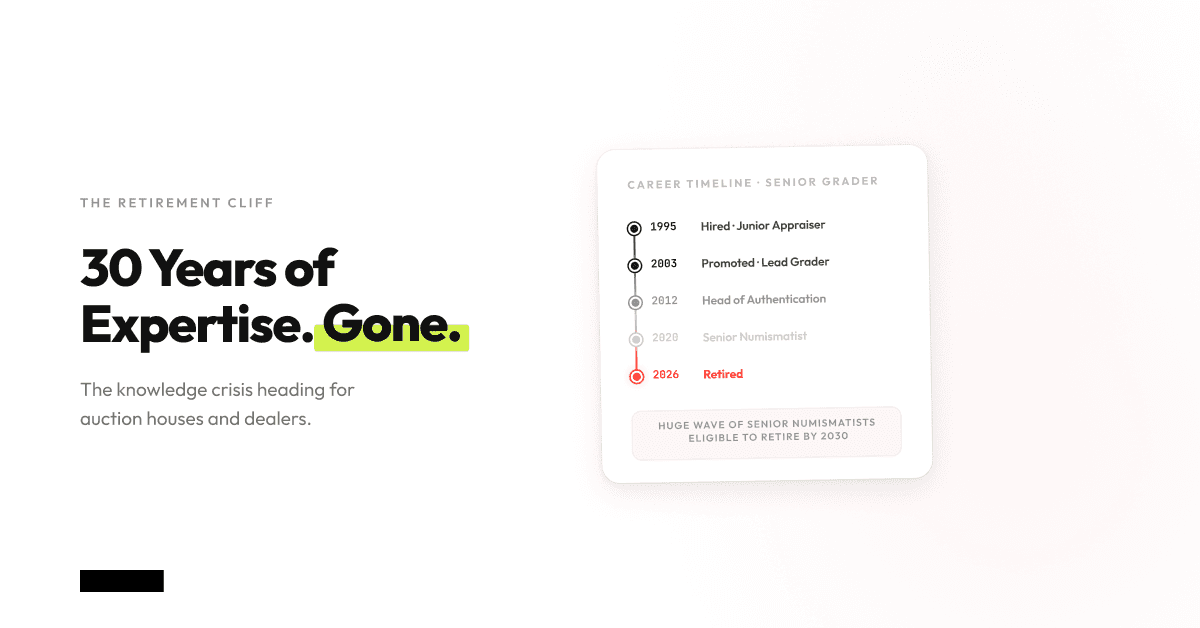
Your senior coin specialist can glance at a tray of Morgan Dollars and spot the cleaned 1893-S before anyone else has picked up a loupe. Your ceramics expert knows which Qing dynasty marks are consistent with period production and which showed up in the 1980s. That knowledge took decades to build. And when those specialists retire, it leaves with them.
This is not a hypothetical problem. By 2030, every baby boomer in the United States will be 65 or older, per the U.S. Census Bureau. For auction houses where senior specialists skew well above the national workforce average age, the auction specialist retirement cliff is not approaching. It is here.
Here is how to diagnose what your auction house stands to lose, and what you can do about it before the consignment pipeline backs up even further.
The Retirement Wave and Auction Industry Workforce Aging
The numbers tell an uncomfortable story. Workers aged 65 and older have grown by 117% over the past two decades, and workers 75 and older are the fastest-growing age group in the U.S. labor force. A total of 75 million baby boomers will reach retirement age by 2030, taking decades of accumulated expertise with them.
Auction houses face a concentrated version of this trend. Authentication, grading, and condition reporting require years of hands-on experience. The collectibles specialist workforce has always skewed older because the expertise takes so long to develop: 5 to 10 years of focused work for basic competence in a single category, and far longer for the senior-level judgment that drives authentication accuracy and hammer price.
Meanwhile, demand is accelerating. The global auction house market reached $65.26 billion in 2025 and is projected to hit $73.61 billion in 2026. The broader collectibles market is valued at $321 billion, with authentication services demand rising 39% across the industry. More consignments require more specialist hours, but the specialists with 20 to 30 years of pattern recognition are heading for the door.
The math is stark: rising volume, shrinking expertise.
What You Actually Lose When a Senior Specialist Retires
Institutional knowledge loss in an auction house is not like losing a sales rep or an operations manager. What walks out is a specific, layered form of expertise that researchers call tacit knowledge: skills and intuitions that are difficult to formalize and communicate because they live in the specialist's hands, eyes, and memory.
The average U.S. business loses $47 million in productivity annually due to inefficient knowledge sharing. For auction houses, where one specialist may be the only person in the building who can authenticate a specific category, the per-person impact is even more concentrated.
Here is what tacit knowledge preservation looks like in practice at an auction house:
Authentication intuition: A veteran numismatist does not just follow a checklist. They recognize die varieties by the weight of a coin in their hand and the way light catches the strike. That kind of pattern recognition comes from handling tens of thousands of pieces over decades.
Market memory: Your senior specialist remembers what a specific 1916-D Mercury Dime brought at auction in 2003, 2011, and 2019. They know which collectors chase specific die varieties and what premiums certain provenances command. This pricing context cannot be looked up in a database because it includes the "why" behind the numbers.
Client relationships: Consignors trust specific people. When a family brings in a grandfather's coin collection for estate intake, they often ask for the specialist by name. Those relationships took years to build and directly affect whether high-value consignments come to your house or go to a competitor.
Condition assessment nuance: The difference between a coin graded AU-58 and MS-61 can mean thousands of dollars in hammer price. Senior specialists develop calibration through years of side-by-side comparison that no written guide fully captures.
Research from NC State University found that only 3% of organizations rate themselves as "extremely effective" at transferring knowledge from retiring employees, while 42% call themselves merely "somewhat effective." In a field where tacit knowledge is the whole game, those numbers should concern every auction house leader.
The Compounding Crisis: Rising Estate Consignment Backlog Meets Fewer Experts
The retirement cliff is not happening in a vacuum. It is colliding with an unprecedented wave of estate consignment backlog driven by the largest generational wealth transfer in history.
Cerulli Associates projects $124 trillion in U.S. wealth transfers by 2048, with the bulk originating from baby boomers and their elders. A significant portion of that wealth sits in physical collections: coins, stamps, baseball cards, fine art, and jewelry. Heirs who do not share the collector's passion are flooding auction houses with entire estates that need sorting, authenticating, and valuing.
The scale of this collision is hard to overstate:
Auction market volume is growing at double-digit rates year over year
Estate collections often contain hundreds or thousands of individual pieces requiring specialist review
Many of these collections include non-traditional or niche items that stretch beyond any single specialist's domain
The cost of manual authentication already runs $25-30 million per category across the industry
If you are already struggling to keep up with your consignment pipeline, imagine losing your most experienced authenticator in the middle of it. The backlog does not pause for succession planning.
This is the same volume problem facing marketplaces that rely on a single expert to handle thousands of monthly listings, and it is compounding the pressure on grading bodies dealing with submission backlogs.
Facing a growing consignment backlog with fewer specialists to process it? Read our guide to why one expert can't handle 25,000 monthly coin listings to understand the scale of the authentication bottleneck across the industry.
How to Build an Auction House Succession Plan Before It Is Too Late
Auction specialist retirement does not have to mean catastrophic knowledge loss. But you need to start before the retirement party, not after. According to the NC State ERM Initiative, only a quarter of organizations effectively manage the pace and timing of employee retirements. Research suggests that the most successful transitions begin two to three years before retirement. Here is how to get into that top tier.
Run a Knowledge Audit
Start by mapping exactly what each senior specialist knows that nobody else does. This is not a performance review; it is an inventory of irreplaceable expertise.
For each specialist nearing retirement, document:
Category-specific authentication skills: What can they spot that junior staff cannot? Which fakes, alterations, or cleaning methods do they catch by instinct?
Pricing knowledge: Which market segments do they track mentally? What comparable sales do they reference that are not in your database?
Client relationships: Which consignors or buyers have personal relationships with this specialist? What happens to those relationships after retirement?
Process shortcuts: What undocumented workflows or quality checks do they perform that are not in your standard operating procedures?
The audit itself is valuable even before you act on it, because it makes the invisible visible. And given that manual authentication costs $25-30 million per category across the industry, understanding exactly what expertise you are about to lose is not optional.
Create Structured Mentorship Timelines
A knowledge audit tells you what to transfer. Mentorship is how you transfer it. The key insight from workforce research is that phased retirement programs, where specialists gradually reduce hours while actively training successors, produce far better expert knowledge transfer than abrupt departures.
Build a 12-to-24-month overlap where the senior specialist and their successor:
Review condition reports side by side, with the specialist explaining their reasoning aloud
Handle the same items independently and compare assessments
Process estate intakes together so the junior specialist absorbs the triage instincts
Co-manage key client relationships with warm introductions
This is time-intensive and expensive. It is also significantly cheaper than the alternative: replacing a specialist costs 30% to 400% of their annual salary, and in a niche field like auction authentication, you are likely at the high end of that range.
Document Authentication Criteria and Condition Standards
Not all tacit knowledge can be transferred through mentorship alone. Some of it needs to be codified into internal reference materials that outlast any single person.
Create reference guides for your highest-volume categories that capture:
Authentication decision trees: Step-by-step diagnostic criteria for the most common fakes and alterations in your specialty areas
Condition grading benchmarks: Photographed reference sets showing grade boundaries (VF-35 vs. EF-40, for example) with the specialist's annotations
Provenance research workflows: Where the specialist looks first, which databases they cross-reference, and what red flags they watch for
These documents will never fully replace a 30-year veteran's judgment. But they create a floor of competence that keeps your operation running while newer staff develop their own expertise.
How Technology Fills the Triage Gap
Even the best auction house succession plan cannot fully close the gap between retiring expertise and growing consignment volume. This is where technology becomes a practical piece of the puzzle: not as a replacement for specialists, but as a triage layer that handles routine work so your remaining experts can focus on what actually requires their judgment.
AI-powered valuation infrastructure trained on 300M+ items can now perform first-pass identification, condition assessment, and pricing estimates in seconds rather than the weeks or months a manual review takes. For coins, purpose-built category models achieve 97-99% authentication accuracy on common items by analyzing mint marks, die varieties, and surface characteristics. This kind of infrastructure is already live and in production for coin authentication, with models for comics, trading cards, and other collectibles categories in development.
The practical application for auction houses navigating expert knowledge transfer challenges is straightforward: let technology handle the 80% of incoming consignments that are relatively standard (common-date coins, typical condition ranges, well-documented types). That frees your human specialists to focus on the 20% that actually need their decades of experience: rare varieties, edge cases, high-value authentication calls, and the nuanced condition assessments that directly impact hammer price.
This is not about replacing your retiring specialists. It is about making sure your remaining team is not buried under routine triage work when they should be spending time on the items that demand real expertise.
Frequently Asked Questions
How long does it take to train an auction specialist?
Developing a competent auction specialist typically takes 5 to 10 years of hands-on experience in a specific category. According to career data from the numismatic industry, entry-level grading positions require certification plus 1-2 years of handling experience before independent work, and senior-level expertise takes considerably longer. Authentication intuition, the ability to spot subtle fakes and alterations at a glance, often requires a decade or more of pattern exposure.
What types of auction house knowledge are hardest to transfer?
Tacit knowledge is the hardest to capture: the intuitive pattern recognition, market memory, and authentication instincts that come from decades of handling specific categories. Research on organizational knowledge loss shows that 42% of institutional knowledge is role-specific and not shared with coworkers. In auction houses, this includes the ability to detect cleaned coins, identify die varieties by feel, and assess condition grades that fall between standard reference points.
Can AI replace a retiring auction specialist?
No. AI can augment remaining specialists by handling first-pass triage on common items, but it cannot replicate the full depth of a senior specialist's judgment on complex authentication, high-value pieces, or client relationships. The most effective approach combines technology for volume triage with human expertise for nuanced decisions. Think of it as infrastructure that raises the floor, not software that replaces the ceiling.
How do auction houses handle specialist retirement today?
Most handle it poorly. Per NC State ERM research, 37% of organizations are "minimally effective" at knowledge transfer from retirees, and only 3% rate themselves as "extremely effective." Common approaches include rehiring retirees as consultants at premium rates, informal mentorship with no structured timeline, or absorbing the loss and hoping remaining staff fill the gap. Structured auction house succession planning with knowledge audits and phased retirement programs remains the exception, not the norm.
Written by
Michael Cox
Want to see Vardera in action?