How AI Authenticates Physical Items at Scale: The Training Data Advantage

Written by
Ben Parfitt
Your trust and safety team flags a listing for a 1909-S VDB Lincoln cent priced at $1,200. The seller's photos look legitimate. The coin's surfaces appear original. But something is off, and you need a definitive answer before the listing goes live to 20 million buyers.
This is where AI authentication training data separates production-grade infrastructure from science projects. The difference between a model that catches that counterfeit and one that waves it through comes down to what the model learned from, and how much of it.
The global AI training dataset market hit $4.44 billion in 2026, but market size tells you nothing about whether a specific model can authenticate physical items at the category level. For that, you need to understand how dataset size, composition, and feedback loops drive accuracy for your specific trust and safety use case.
Why Generic AI Falls Short on Physical Item Authentication
Generic image recognition models can identify a coin. They cannot authenticate one. That distinction matters when your marketplace processes 25,000+ coin listings per month and a single counterfeit sale triggers chargebacks, buyer complaints, and regulatory scrutiny.
The stakes are real. The counterfeit coin detection market reached $420 million in 2024, with fake coin detections rising 19% in the first half of 2024 alone, according to industry monitoring data. Counterfeiters are getting better. Your detection infrastructure needs to stay ahead.
General-purpose computer vision models train on broad datasets like ImageNet, which contains roughly 14 million images across 20,000+ categories. These models learn to distinguish "coin" from "watch" from "handbag." But AI counterfeit detection training requires a fundamentally different kind of data: millions of examples within a single category, annotated by domain experts who understand what separates genuine from fake.
Consider what authentication actually requires for coins alone:
Mint mark analysis: Distinguishing a genuine "S" mint mark from one that was added, altered, or tooled after production
Die variety identification: Recognizing the specific die pair that struck a coin from microscopic flow lines and strike characteristics
Surface diagnostics: Detecting cleaning, artificial toning, environmental damage, and re-engraved details
Edge lettering and reeding: Verifying characteristics that counterfeiters frequently get wrong
A model trained on 20,000 general product images might achieve 94% accuracy on broad product categories, per research from academic collaborators studying counterfeit detection. But 94% accuracy on 25,000 monthly listings means 1,500 misclassified items hitting your marketplace every month. That is not a trust and safety solution; it is a liability.
This is why AI coin condition assessment demands purpose-built, domain-specific AI datasets rather than repurposed general models.
What Makes AI Authentication Training Data Defensible
Not all training data creates a competitive advantage. A defensible dataset for physical item authentication rests on three pillars: scale, diversity, and annotation quality. Together, they form a data moat that competitors cannot replicate without years of investment.
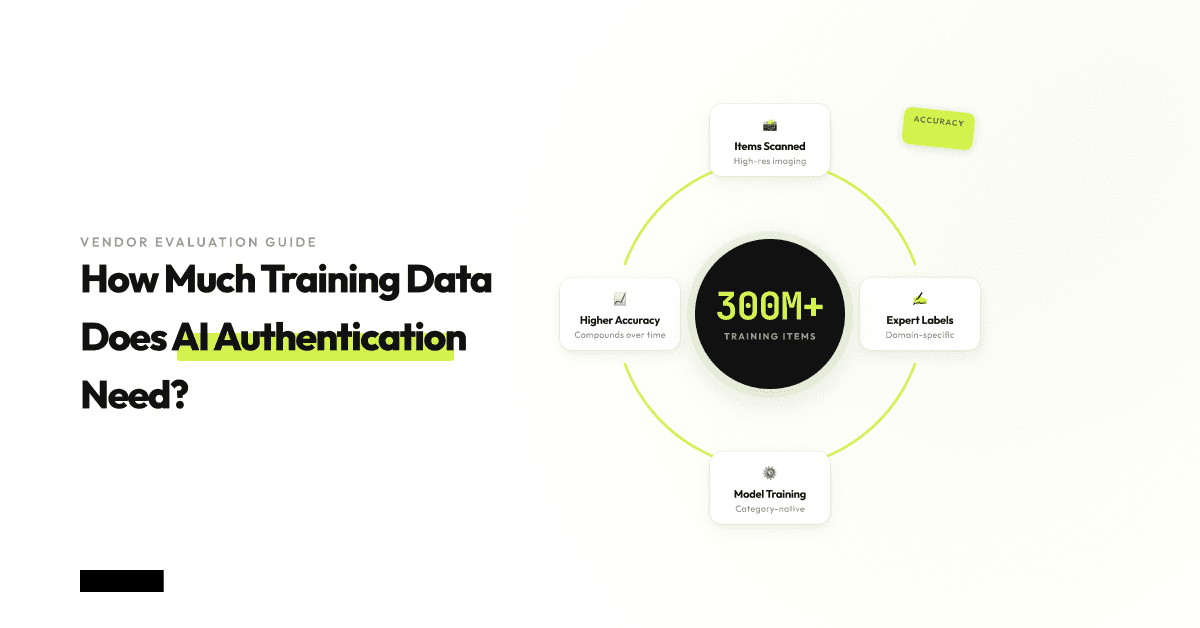
Scale: Volume creates coverage. A proprietary dataset of 400M+ unique items provides the statistical foundation for high-accuracy authentication. At this scale, the model has seen enough examples of genuine and counterfeit items across every grade, denomination, and era to make reliable distinctions. Research from IBM confirms that models trained on high-quality structured data consistently demonstrate better accuracy and generalization compared to those trained on smaller or noisier datasets.
Diversity: Edge cases define real-world performance. Authentication accuracy is not determined by how well a model handles obvious counterfeits. It is determined by how it handles the hard cases: a cleaned coin that a novice might mistake for original surfaces, a high-quality counterfeit with correct weight and composition, or environmental damage that mimics artificial alteration. A proprietary dataset authentication approach must include these edge cases in sufficient volume for the model to learn the subtle differences.
Annotation quality: Expert labels drive precision. The gap between data moat AI accuracy and generic model performance often comes down to who labeled the training data. Coin authentication annotations require specialists who understand grading standards, die varieties, and surface characteristics. NIST research highlights that AI bias extends beyond the data itself to include how data is collected, selected, and annotated. Expert annotation addresses these risks at the source.
The cost of building this kind of dataset from scratch reinforces its defensibility. Building an in-house authentication dataset for a single category typically requires $1-3M in investment and 1-2 years of development time. That timeline and cost make the dataset itself a barrier to entry.
How Dataset Composition Drives Authentication Accuracy
Understanding what goes into deep category model training data clarifies why dataset composition, not just size, determines production accuracy. Two datasets of equal size can produce wildly different results depending on their internal structure.
Grade Distribution Coverage
A coin can grade anywhere from Poor-1 to Mint State-70 on the Sheldon scale. If your training data skews heavily toward high-grade examples (because those are more commonly photographed and sold), the model will underperform on circulated coins that make up the bulk of marketplace listings. Effective domain-specific AI datasets maintain proportional coverage across the entire grade spectrum.
Edge Case Density
The highest-value training examples are not the obvious ones. They are the borderline cases:
Coins with original surfaces that look cleaned
Counterfeits that pass weight and dimension tests
Altered dates or mint marks on otherwise genuine coins
Environmental damage patterns that vary by storage conditions
Models trained on Vardera Labs' 400M+ item dataset achieve 97-99% authentication accuracy precisely because the dataset includes sufficient edge case coverage. Each edge case the model learns from prevents a category of false positives or false negatives in production. Research from AIMultiple confirms that poor data quality can reduce AI performance by over 20%, even with large datasets, which is why composition quality matters as much as raw volume.
Population and Market Intelligence
Authentication does not happen in isolation. A model that understands population data and price trends can flag statistical anomalies. When a coin with a known surviving population of 50 examples suddenly appears in volume on your marketplace, that context layer adds a trust and safety signal that pure image analysis misses.
The AI coin authentication workflow integrates these data dimensions: visual features, population intelligence, and market context combine to produce a confidence score that your trust and safety team can act on.
The Data Flywheel: Why Authentication Accuracy Compounds Over Time
Static datasets decay. An authentication data flywheel is what separates a point-in-time model from infrastructure that gets smarter with every transaction.
NVIDIA defines a data flywheel as a self-reinforcing loop where AI models continuously improve by learning from the latest data and user feedback. Each iteration does not just make the model slightly better; it accelerates the rate of improvement.
Here is how the flywheel works for authentication in practice:
Ingestion: A marketplace listing is submitted with photos and metadata
Analysis: The model authenticates the item using its current training
Feedback: The result (confirmed authentic, flagged counterfeit, or edge case requiring review) generates new labeled data
Retraining: New labeled data is incorporated into the next model iteration
Improvement: The updated model handles similar cases with higher confidence
Each cycle through the flywheel adds to the dataset's coverage and the model's accuracy. Vardera Labs' coin model, the world's first production-grade coin category model, is live and processing real marketplace listings. Every item it analyzes makes the next analysis more accurate.
This compounding dynamic creates a structural advantage that widens over time. A competitor starting today faces two challenges: replicating the existing 300M+ item dataset (which took years and millions of dollars to build), and closing the gap on ongoing production data that continues to grow daily.
The flywheel also accelerates cross-category expansion. Patterns learned in coin authentication, such as surface analysis techniques and counterfeit detection heuristics, transfer to adjacent categories. Vardera Labs has 6+ category models on its roadmap (coins, comics, trading cards, handbags, wine, toys), and each new category benefits from shared learnings across the platform.
Evaluating AI Authentication Vendors: What to Ask About Their AI Item Authentication Dataset
If you are responsible for trust and safety on a marketplace spending $25-30M per category on manual authentication teams, evaluating AI vendors requires looking beyond marketing claims. Here are the questions that separate production-grade API infrastructure from demos.
1. What is your total training dataset size, and how is it composed? Ask for specifics: total unique items, grade distribution, edge case coverage, and category depth. A vendor claiming "millions of images" without explaining composition is a red flag. Size without diversity produces a model that is confidently wrong on the cases that matter most.
2. Who labels your training data, and what are their qualifications? Expert annotation is the difference between a dataset and a production asset. Ask whether labeling is done by domain specialists or crowd-sourced workers. The answer directly correlates with accuracy on borderline cases.
3. Does your model improve with production usage? This question tests for the flywheel. A vendor with a static dataset will plateau. A vendor with a production feedback loop will compound accuracy over time. Ask for evidence of accuracy improvement between model versions.
4. What is your accuracy at the category level, not just overall? Overall accuracy across all categories is a vanity metric. Category-level accuracy matters. A model that achieves 99% on coins but 85% on comics is not ready for comics. Demand category-specific SLAs.
5. How do you handle new counterfeiting techniques? Counterfeiters adapt. Ask how quickly the vendor's model learns from newly discovered counterfeit methods. The answer reveals whether their dataset and training pipeline are designed for ongoing threat evolution.
Evaluation Criteria | Strong Indicator | Weak Indicator |
|---|---|---|
Dataset size | 100M+ items, category-specific | "Millions of images" (vague) |
Annotation quality | Domain expert labelers | Crowd-sourced labels |
Accuracy metric | Category-level SLA (97%+) | Overall accuracy only |
Production feedback | Live flywheel with retraining | Static, versioned model |
Edge case coverage | Documented edge case categories | Not disclosed |
Frequently Asked Questions
How much training data does an AI authentication model need to be production-ready?
There is no universal threshold, but the relationship between dataset size and accuracy follows a logarithmic curve: early data additions produce large accuracy gains, while later additions produce smaller but critical improvements on edge cases. For physical item authentication, production-grade accuracy (97%+) typically requires tens of millions of expert-annotated examples within a single category, according to research on AI data quality and model performance.
Can a marketplace build its own authentication training dataset?
Yes, but the cost and timeline are significant. Building a production-quality dataset for a single category typically requires $1-3M in investment and 1-2 years of development. That estimate covers data acquisition, expert annotation, edge case curation, and model training infrastructure. Most marketplaces find that partnering with a specialized API infrastructure provider offers better unit economics than building in-house.
How does AI authentication training data differ from general computer vision datasets?
General computer vision datasets like ImageNet contain broad category coverage with relatively shallow depth per category. Authentication datasets require the inverse: extremely deep coverage within a single category, with expert annotations on attributes that general labelers cannot identify. The distinction is analogous to the difference between a general practitioner and a specialist: both are doctors, but only the specialist can diagnose the rare condition.
Does more training data always mean better accuracy?
Not automatically. Dataset quality matters as much as quantity. A 300M item dataset with poor labels or skewed grade distribution will underperform a smaller, well-curated dataset. The most defensible approach combines scale with expert annotation, diverse edge case coverage, and a production feedback loop that continuously improves data quality. Research from AIMultiple confirms that poor data quality can reduce AI performance by over 20%, even with large datasets.
Your Training Data Evaluation Checklist
The next time an AI vendor pitches you on authentication accuracy, use this framework:
Ask for total dataset size with category-level breakdowns
Request edge case coverage documentation
Verify annotation is done by domain experts, not crowd workers
Confirm the model operates on a production feedback loop
Demand category-specific accuracy SLAs, not just aggregate numbers
Ask how the model adapts to new counterfeiting techniques
The platforms that win on trust and safety over the next five years will be the ones that treat AI authentication training data as core infrastructure, not a vendor checkbox. The data moat compounds. The question is whether you are building yours or borrowing someone else's.
Written by
Ben Parfitt
Want to see Vardera in action?