Coin Valuation Software: AI Grading for Numismatics

Written by
Derek Bugley
A head of appraisal at a regional auction house described the scene this way: 3,800 coins from a single estate consignment, delivered on a Tuesday, sitting on her desk next to the Persian rugs and trading cards also needing her attention. At two minutes per coin of careful review, that is 127 hours of work on the coins alone, and the senior specialist who trained her retired eighteen months ago.
This is the real problem coin valuation software is now being asked to solve, and it is why the category is quietly splitting in two. The hobbyist inventory apps that dominate the search results are not what an auction house, grading body, or professional dealer actually needs. They need category intelligence that can triage a backlog, identify varieties, and assess condition at production scale.
This article gives you the framework: a three-tier mental model, the five criteria that separate serious buyers from casual ones, and a short checklist for your next vendor call. If you run a consignment pipeline, manage submission volume at a grading body, or oversee coin cataloging at scale, this is written for you.
What Coin Valuation Software Actually Does in 2026
The phrase "coin valuation software" covers three different categories of offering that solve three different problems for three different buyers. Conflating them is the main reason buyers end up with the wrong product.
Tier 1: Hobbyist inventory and numismatic software. Desktop and web apps like CoinManage, Liberty Street, OpenNumismat, and MyCoinWorX. Their job is to help a collector catalog what they own, cross-reference it against a built-in price database, and generate reports. Adjacent to this tier is traditional coin dealer software like Stack's Bowers Orion, which adds inventory and sales workflow but stops short of AI valuation. Useful for a collection of a few hundred coins. Not designed for professional throughput and not integrated into a production grading workflow.
Tier 2: Consumer AI coin identifiers and coin grading software. Mobile apps like CoinSnap, Coinoscope, HeritCoin, and web offerings like CoinsWorth and CoinGrader AI. These use computer vision to identify a coin from a photo, estimate a Sheldon-scale grade, and pull market values from public databases. The best hit 93 to 95 percent on identification for common US coinage. Useful for a collector pre-checking what they have. Not designed for bulk processing, not auditable at the single-decision level, and not integrated with cataloging or consignment systems.
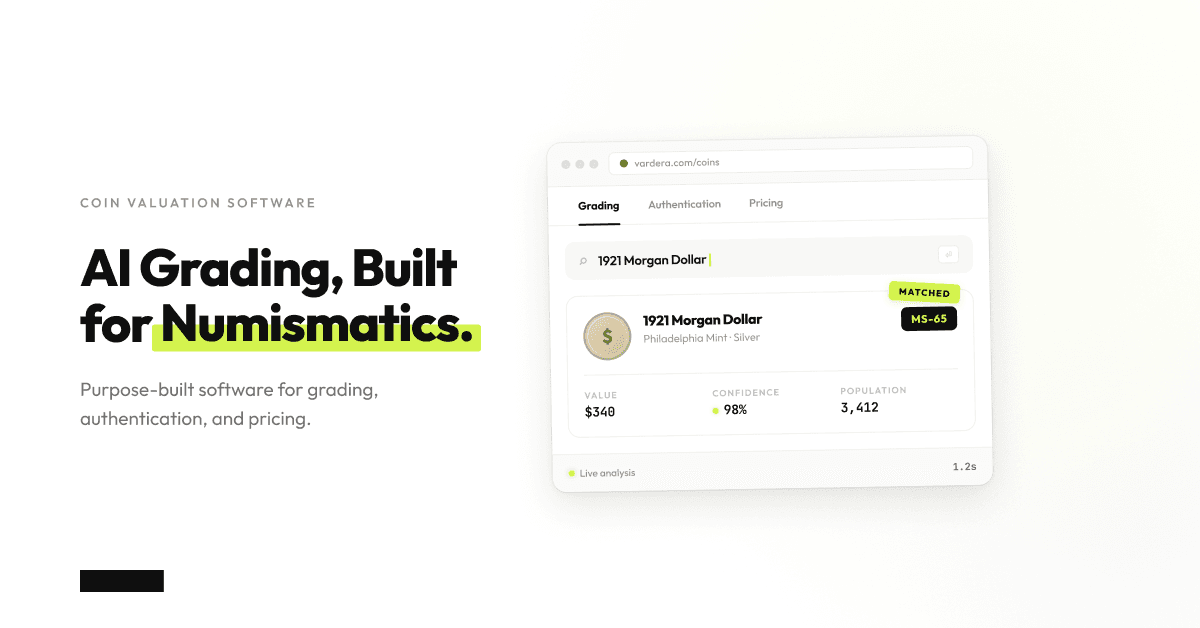
Tier 3: Production-grade valuation infrastructure delivered via API. Purpose-built deep category models that act as a virtual world-class expert for a specific asset category, reaching 97 to 99 percent authentication accuracy on coins and processing items in seconds rather than days. Vardera's coin category model sits in this tier and is live in production today. These are not dashboards your graders log into. They are infrastructure, a valuation layer that plugs into your existing tech stack the way Stripe plugs into a checkout flow. The buyer is a marketplace, a grading body, an auction platform, or a dealer network, not an individual collector.
If your job is helping one collector catalog 400 coins, Tier 1 is the answer. If your job is clearing a backlog of 3,800 coins before next Friday's consignment deadline, Tier 1 will not save you and Tier 2 will leave you with decisions you cannot defend to a consignor. The rest of this article is about what a professional buyer should evaluate before writing a check.
What to Look For in Coin Valuation Software: The Buyer-Criteria Framework
Five criteria separate software that looks impressive on a landing page from software that holds up in a production workflow. Ask every vendor about all five, and you will quickly see which conversations are worth continuing.
Accuracy Benchmarks, and How to Read Them Honestly
Every vendor claims high accuracy. The question is how they define and measure it. A useful benchmark specifies three things: the size and composition of the test set, the ground-truth labeling methodology, and the accuracy by grade tier. A headline "99 percent accurate" that collapses those dimensions is a red flag.
Production-grade coin models now reach 97 to 99 percent authentication accuracy when measured against PCGS or NGC-graded reference coins, with well-designed models reporting accuracy separately for the high end of the Sheldon scale (MS65 and above) where grade disputes have the most dollar impact. Ask any vendor to show you their test-set size, ground-truth labeling method, and accuracy by grade tier. If they cannot answer in concrete numbers, they do not have a real benchmark.
This criterion matters most to grading-body operations leaders. A wrong grade at scale erases brand equity that took decades to build.
Training Data Scale and Breadth
Dataset size matters because edge cases are where models fail and where domain expertise earns its keep. A Morgan-dollar-only dataset of 500,000 coins will miss varieties that a 400M-item dataset spanning every series, mint mark, and mint-error category catches without being told to look. Breadth, recency, and whether the dataset grows with usage matter more than raw item count.
The strongest production models are trained on proprietary datasets that span multiple asset categories and compound with every authentication. This creates a data moat an in-house build cannot match, because an in-house team sees only its own items while a vendor model sees every customer's items. Ask vendors: how many items, what breadth across series and varieties, how often updated, and does the model learn from customer usage.
API and Infrastructure Posture: Is This Software or Is This a Layer?
The single most important Tier-2-vs-Tier-3 filter: does the software plug into your existing stack, or is it a separate screen your graders have to learn? If you run modern auction software like Bastia, Jupiter, or LiveAuctioneers, or a marketplace backend, you need infrastructure that exposes an API, accepts webhook calls, and can be wired into your consignment intake or listing pipeline.
The Stripe analogy is not decoration. Before Stripe, merchants either built their own payment stack or pasted a third-party checkout iframe onto their site. Stripe made payments into infrastructure that sits invisibly inside a merchant's product. Coin valuation is at the same inflection point. Production-grade vendors deliver a valuation layer through APIs, SDKs, and platform partnerships, not through a login screen.
Auditability and Explainability
When a consignor asks why a coin graded MS66 instead of MS67, or when a grading-body customer asks why a submission was flagged as counterfeit, "the AI said so" is not an acceptable answer. A production-grade model logs decisions with versioned model weights, surfaces the visual features it weighted most heavily, and lets an operator step back into the loop without losing context.
Auditability has three components: decision logging with timestamps and model versions, feature-level explainability (which die marks, surface areas, or rim details drove the grade), and a clean handoff path back to a human expert. For counterfeit detection specifically, auditability means the model can point to the specific casting variance or die signature that triggered the flag. This criterion matters most to grading operations, but it saves the head of appraisal's reputation too the first time a consignor pushes back on a grade.
Integration Fit With Existing Grading and Cataloging Workflows
The goal of production-grade coin valuation software is not to add another tab to your day. It is to augment your existing workflow so that the 80 percent of clearly-gradable coins get triaged by the model and your human experts focus on the 20 percent that need their judgment. Good integration looks like: pre-screening submissions before PCGS or NGC grading, running as coin authentication software that flags counterfeits before a coin is listed, auto-generating catalog copy and lot descriptions, and routing edge cases to the specialists who should see them.
Ask vendors to walk you through a single coin from photograph to cataloged lot, showing exactly where the model sits in the path and what handoffs exist with your existing systems. If the answer involves anyone leaving their current workflow to log into a new dashboard, you are looking at Tier 2 software being sold as Tier 3.
How AI Coin Grading Works Under the Hood, Enough to Evaluate a Vendor
You do not need to be an ML engineer to buy this software, but you should know enough to spot bad answers to technical questions. Production-grade coin models use computer vision trained on millions of reference coins to analyze obverse and reverse photographs and assess identity, condition, authenticity, and market value as a bundled output.
Computer vision coin identification analyzes surface condition (bag marks, hairlines, carbon spots), luster, strike sharpness, die characteristics (cracks, doubling, repunched mint marks), edge detail, and rim integrity. Category-specific models purpose-built for US coinage outperform general-purpose AI because they are trained on the specific die varieties, mint-error categories, and counterfeit patterns that matter for the asset class. A general-purpose image model will not know that a 1916-D Mercury dime with a strong "D" in the right position is genuine while the same dime with a thin, off-center "D" is likely an altered-date counterfeit.
Image capture matters. Most production-grade models expect standardized lighting and positioning, and accuracy degrades on phone photos in kitchen lighting. When a vendor says the model works on any photograph, ask for accuracy numbers on non-standardized images. For the full technical explanation, see the complete guide to AI coin grading and valuation.
Can AI Grade a Coin? Answering the Skeptic's Question
Yes, within specific and honest limits. Production-grade AI grades coins to within plus-or-minus one point on the Sheldon scale for the vast majority of commonly-traded series, processing items in seconds rather than the days or weeks human grading takes. For coins outside its training distribution (obscure ancient coinage, heavily worn pieces below MS60, experimental patterns), human expertise still wins.
The right framing is augmentation. AI handles the 80 to 90 percent of clearly-gradable coins at production throughput, and human graders focus on the 10 to 20 percent that require judgment or category expertise the model has not seen before. Automated coin appraisal is a hybrid workflow where AI takes the routine volume so the experts can do the work that genuinely needs them.
One thing AI does not do: replicate the market authority of a PCGS or NGC holder. A certified coin in professional plastic commands a market premium because decades of trust have been built into those certification authorities, and no model trained this year will substitute for that trust. What AI does is pre-grade your coins so you know which are worth the 22-to-150-dollar submission fee and which are not.
Build-vs-Buy Economics for Enterprise Coin Valuation
Run the math both ways before buying. The build-it-yourself path for a category-specific coin AI is roughly $1M to $3M and 12 to 24 months, assuming you can recruit the right ML engineers and domain experts, and that is just to reach version one. Ongoing maintenance is often larger than the initial build: models drift, new counterfeit patterns emerge, mint releases add varieties, and the team that built version one has to stay together to keep it working.
The manual-authentication status quo at marketplace scale runs $25M to $30M per category per year, and every large marketplace that has tried to authenticate listings without infrastructure has hit the same wall: one expert cannot review 25,000 new listings per month, and hiring ten experts does not solve the unit cost. This is the cost frame Vardera was built to answer. Read it as "buy infrastructure instead of burning cash on human ops" or as "build in-house if coin valuation is your entire business model," but the one wrong answer is to scale the manual team linearly and hope.
The second hidden factor is the compounding data flywheel. A vendor model sees every customer's items and learns from every authentication. An in-house model sees only your own items and improves linearly at best. Over 18 to 24 months, the gap grows wide enough that in-house teams find themselves maintaining a model that performs worse than what a vendor delivers off the shelf. The defensible data moat is on the vendor side of the equation.
A short decision frame: if coin valuation is a cost center rather than a core business, buy infrastructure. If you are a grading body whose brand is built on the certification you issue, partner for a pre-grading layer and keep the final human grade as your product. If you are a marketplace whose trust and safety cost is growing faster than category revenue, buy the category model and redeploy the human budget to edge cases.
A Short Buyer's Checklist: Use This Before Your Next Vendor Call
Seven questions that will filter any vendor conversation quickly:
Accuracy: "Show me your benchmark, test-set size, ground-truth labeling methodology, and accuracy broken out by grade tier." A real answer names numbers. A hand-wave is disqualifying.
Training data: "How many items, what breadth across series and varieties, how often updated, and does the model learn from customer usage?" The breadth and flywheel matter more than the raw item count.
Infrastructure: "Do you offer an API? Which auction software, marketplace platforms, or grading-ops systems do you integrate with today?" If the answer is "we have a web app," you are talking to Tier 2.
Auditability: "Walk me through how a single grade decision is logged, how I can explain it to a consignor, and what the handoff path looks like when a human grader needs to override."
Workflow fit: "Walk me through one coin from photograph to cataloged lot in my existing stack. Where does your model sit, and what tools does my team keep using?"
Pricing and pilot: "What does a proof-of-concept look like? Per-item pricing, subscription, or enterprise contract?" The price structure reveals who the vendor thinks the buyer is.
Reference customers: "Who else at roughly my scale is running this in production, and can I talk to them?" The strongest vendors will happily connect you; the weakest will find reasons you cannot.
Coin Valuation Software FAQ
Can AI grade a coin?
Yes. Production-grade AI grades coins to within plus-or-minus one point on the Sheldon scale for most commonly-traded US series, processing items in seconds. Accuracy on high-grade coins (MS65 and above) is lower than on circulated grades, and obscure or heavily-worn coins still require human expertise. The practical use is pre-grading and triage, not replacing PCGS or NGC certification authority.
What's the difference between coin inventory software and coin valuation software?
Inventory software (CoinManage, OpenNumismat) catalogs what you own and looks up prices from a built-in database. It does not assess condition or authenticate anything. Valuation software uses computer vision to identify each coin, grade its condition, flag counterfeits, and estimate market value. Inventory is built for collectors; valuation is built for professionals processing coins at throughput.
Does coin valuation software work with PCGS or NGC certified coins?
Yes. Production-grade coin valuation software works alongside certification services, not against them. Common workflows include pre-grading raw coins to decide which are worth professional submission, reading certification numbers from slab labels, and cross-referencing the model's independent assessment against the certified grade for quality control.
How much does coin valuation software cost?
Pricing varies by tier. Consumer apps are free to low single digits per month. Dealer inventory software runs tens to a few hundred dollars per month per user. Enterprise production-grade infrastructure is typically priced per-item processed or as an annual contract, and is usually a direct sales conversation rather than a public price list.
Is there a free coin valuation tool for professional use?
Not really. Free tools exist at the consumer tier (OpenNumismat is open-source, PCGS CoinFacts is free to browse), but production-grade valuation infrastructure is not a free product category. The ongoing cost of dataset maintenance, retraining, and API availability is real, and any vendor offering enterprise-grade throughput at zero cost is either burning venture capital or not offering enterprise-grade throughput.
Turning the Framework Into a Decision
The coin valuation software market is splitting into two categories that share a name but solve different problems. Hobbyist inventory and consumer AI identifiers are the right answer for a collector working through 400 coins on a Saturday. For a head of appraisal with 3,800 coins on the desk, a grading body watching submission volume outpace hiring, or a marketplace spending tens of millions on manual authentication per category, they are not. Production-grade infrastructure is.
The buyers who will build a durable throughput advantage over the next 18 to 24 months are the ones treating coin valuation as infrastructure rather than as another piece of desktop software. They ask every vendor for accuracy benchmarks with real methodology, training datasets that are broad and growing, API posture that plugs into their existing stack, audit trails they can defend to a consignor, and workflow integration that augments rather than replaces their experts. For deeper context on the coin valuation process step by step, or how the underlying AI grading technology actually works, the linked guides go further than this article can. The coins are already on the desk.
Written by
Derek Bugley
Want to see Vardera in action?